


p107 Rabbit pAb
-YT3484




主要信息
Target
p107
Host Species
Rabbit
Reactivity
Human, Mouse
Applications
IF, ELISA
MW
121kD (Calculated)
Conjugate/Modification
Unmodified
货号: YT3484
规格
价格
货期
数量
200μL
¥3,780.00
现货
0
100μL
¥2,300.00
现货
0
40μL
¥960.00
现货
0
加入购物车


已收藏
收藏
详细信息
推荐稀释比
IF 1:200-1:1000; ELISA 1:5000; Not yet tested in other applications
组成
Liquid in PBS containing 50% glycerol, 0.5% BSA and 0.02% sodium azide.
特异性
p107 Polyclonal Antibody detects endogenous levels of p107 protein.
纯化工艺
The antibody was affinity-purified from rabbit antiserum by affinity-chromatography using epitope-specific immunogen.
储存
-15°C to -25°C/1 year (Do not lower than -25°C)
浓度
1 mg/ml
理论分子量
121kD
修饰
Unmodified
克隆性
Polyclonal
同种型
IgG
相关产品
Secondary Antibodies
Goat Anti Mouse IgG(H+L) (HRP)
RS0001
预览→
Secondary Antibodies
Goat Anti Rabbit IgG(H+L) (HRP)
RS0002
预览→
Primary Antibodies
β-actin (PTR2364) Mouse mAb
YM3028
预览→
Primary Antibodies
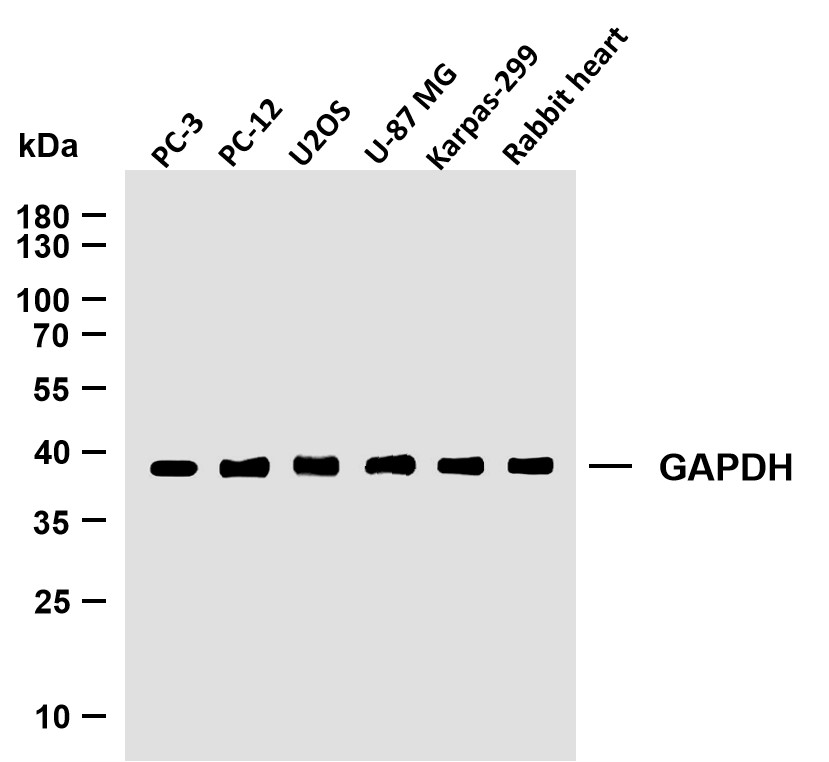
GAPDH (PTR2304) Mouse mAb
YM3029
预览→
抗原&靶点信息
免疫原:
The antiserum was produced against synthesized peptide derived from human RBL1. AA range:335-384
展开内容
特异性:
p107 Polyclonal Antibody detects endogenous levels of p107 protein.
展开内容
基因名称:
RBL1
展开内容
蛋白名称:
Retinoblastoma-like protein 1
展开内容
别名:
RBL1 ;
Retinoblastoma-like protein 1 ;
107 kDa retinoblastoma-associated protein ;
p107 ;
pRb1
Retinoblastoma-like protein 1 ;
107 kDa retinoblastoma-associated protein ;
p107 ;
pRb1
展开内容
背景:
The protein encoded by this gene is similar in sequence and possibly function to the product of the retinoblastoma 1 (RB1) gene. The RB1 gene product is a tumor suppressor protein that appears to be involved in cell cycle regulation , as it is phosphorylated in the S to M phase transition and is dephosphorylated in the G1 phase of the cell cycle. Both the RB1 protein and the product of this gene can form a complex with adenovirus E1A protein and SV40 large T-antigen , with the SV40 large T-antigen binding only to the unphosphorylated form of each protein. In addition , both proteins can inhibit the transcription of cell cycle genes containing E2F binding sites in their promoters. Due to the sequence and biochemical similarities with the RB1 protein , it is thought that the protein encoded by this gene may also be a tumor suppressor. Two transcript variants encoding different isoforms hav
展开内容
功能:
Function:Key regulator of entry into cell division. Directly involved in heterochromatin formation by maintaining overall chromatin structure and , in particular , that of constitutive heterochromatin by stabilizing histone methylation. Recruits and targets histone methyltransferases SUV420H1 and SUV420H2 , leading to epigenetic transcriptional repression. Controls histone H4 'Lys-20' trimethylation. Probably acts as a transcription repressor by recruiting chromatin-modifying enzymes to promoters. Potent inhibitor of E2F-mediated trans-activation. Forms a complex with adenovirus E1A and with SV40 large T antigen. May bind and modulate functionally certain cellular proteins with which T and E1A compete for pocket binding. May act as a tumor suppressor. ,PTM:Exists in both phosphorylated and unphosphorylated forms , and T , but not E1A , binds only to the unphosphorylated form. Cell-cycle arrest properties are inactivated by phosphorylation on Thr-332 , Ser-640 , Ser-964 and Ser-975 by CDK4. ,similarity:Belongs to the retinoblastoma protein (RB) family. ,subunit:Interacts with SUV420H1 and SUV420H2 (By similarity) . Component of the DREAM complex (also named LINC complex) at least composed of E2F4 , E2F5 , LIN9 , LIN37 , LIN52 , LIN54 , MYBL1 , MYBL2 , RBL1 , RBL2 , RBBP4 , TFDP1 and TFDP2. The complex exists in quiescent cells where it represses cell cycle-dependent genes. It dissociates in S phase when LIN9 , LIN37 , LIN52 and LIN54 form a subcomplex that binds to MYBL2. Interacts with AATF. Interacts with KDM5A. Interacts with SV40 and JC virus large T antigens. ,
展开内容
细胞定位:
Nucleus .
展开内容
组织表达:
展开内容
研究领域:
>>Cell cycle ;
>>Cellular senescence ;
>>TGF-beta signaling pathway ;
>>Human papillomavirus infection ;
>>Viral carcinogenesis
>>Cellular senescence ;
>>TGF-beta signaling pathway ;
>>Human papillomavirus infection ;
>>Viral carcinogenesis
展开内容
信号通路
文献引用({{totalcount}})
货号: YT3484
规格
价格
货期
数量
200μL
¥3,780.00
现货
0
100μL
¥2,300.00
现货
0
40μL
¥960.00
现货
0
加入购物车
已收藏
收藏
Recently Viewed Products
Clear all


×

Toggle night Mode
{{pinfoXq.title || ''}}
Catalog: {{pinfoXq.catalog || ''}}
Filter:
All
{{item.name}}
{{pinfo.title}}
-{{pinfo.catalog}}
主要信息
Target
{{pinfo.target}}
Reactivity
{{pinfo.react}}
Applications
{{pinfo.applicat}}
Conjugate/Modification
{{pinfo.coupling}}/{{pinfo.modific}}
MW (kDa)
{{pinfo.mwcalc}}
Host Species
{{pinfo.hostspec}}
Isotype
{{pinfo.isotype}}
产品 {{index}}/{{pcount}}
上一个产品
下一个产品
{{pvTitle}}
滚轮缩放图片
{{pvDescr}}