



TGF β Receptor II (PT0368R) PT™ Rabbit mAb
-YM8220






主要信息
Target
TGF β Receptor II
Host Species
Rabbit
Reactivity
Human, Mouse, Rat
Applications
WB, IHC, IF, IP, ELISA
MW
65kD (Calculated)
65kD (Observed)
Conjugate/Modification
Unmodified
货号: YM8220
规格
价格
货期
数量
200μL
¥3,580.00
现货
0
100μL
¥1,960.00
现货
0
40μL
¥960.00
现货
0
加入购物车


已收藏
收藏
详细信息
推荐稀释比
IHC 1:200-1:500; WB 1:1000-1:5000; IF 1:200-1:1000; ELISA 1:5000-1:20000; IP 1:50-1:200,
Note: For IHC, we suggest antigen retrieval with TE buffer pH 9.0 (Cat#YS0004)
Note: For IHC, we suggest antigen retrieval with TE buffer pH 9.0 (Cat#YS0004)
组成
PBS, 50% glycerol, 0.05% Proclin 300, 0.05%BSA
特异性
Endogenous
纯化工艺
Protein A
储存
-15°C to -25°C/1 year(Do not lower than -25°C)
理论分子量
65kD
实测条带
65kD
修饰
Unmodified
克隆性
Monoclonal
克隆号
PT0368R
同种型
IgG,Kappa
相关产品
Primary Antibodies

TGF β Receptor II Rabbit pAb
YT4629
预览→
Primary Antibodies

TGF β Receptor II (Phospho Ser225) Rabbit pAb
YP1013
预览→
ELISA Kits

Human TGF β RII ELISA Kit
KE1165
预览→
ELISA Kits
Total TGF β RII Cell-Based Colorimetric ELISA Kit
KA3388C
预览→
ELISA Kits
Total TGF β RII Cell-Based Colorimetric ELISA Kit
KA3193C
预览→
抗原&靶点信息
特异性:
Endogenous
展开内容
基因名称:
TGFBR2
展开内容
蛋白名称:
TGF-beta receptor type-2
展开内容
别名:
TGFBR2 ;
TGF-beta receptor type-2 ;
TGFR-2 ;
TGF-beta type II receptor ;
Transforming growth factor-beta receptor type II ;
TGF-beta receptor type II ;
TbetaR-II
TGF-beta receptor type-2 ;
TGFR-2 ;
TGF-beta type II receptor ;
Transforming growth factor-beta receptor type II ;
TGF-beta receptor type II ;
TbetaR-II
展开内容
背景:
This gene encodes a member of the Ser/Thr protein kinase family and the TGFB receptor subfamily. The encoded protein is a transmembrane protein that has a protein kinase domain, forms a heterodimeric complex with another receptor protein, and binds TGF-beta. This receptor/ligand complex phosphorylates proteins, which then enter the nucleus and regulate the transcription of a subset of genes related to cell proliferation. Mutations in this gene have been associated with Marfan Syndrome, Loeys-Deitz Aortic Aneurysm Syndrome, and the development of various types of tumors. Alternatively spliced transcript variants encoding different isoforms have been characterized. [provided by RefSeq, Jul 2008],
展开内容
功能:
Catalytic activity:ATP + [receptor-protein] = ADP + [receptor-protein] phosphate.,cofactor:Magnesium or manganese.,Disease:Defects in TGFBR2 are a cause of esophageal cancer [MIM:133239].,Disease:Defects in TGFBR2 are the cause of aortic aneurysm familial thoracic type 3 (AAT3) [MIM:610380]. Aneurysms and dissections of the aorta usually result from degenerative changes in the aortic wall. Thoracic aortic aneurysms and dissections are primarily associated with a characteristic histologic appearance known as 'medial necrosis' or 'Erdheim cystic medial necrosis' in which there is degeneration and fragmentation of elastic fibers, loss of smooth muscle cells, and an accumulation of basophilic ground substance. AAT3 is an autosomal dominant disorder with reduced penetrance and variable expression.,Disease:Defects in TGFBR2 are the cause of hereditary non-polyposis colorectal cancer type 6 (HNPCC6) [MIM:190182]. Mutations in more than one gene locus can be involved alone or in combination in the production of the HNPCC phenotype (also called Lynch syndrome). Most families with clinically recognized HNPCC have mutations in either MLH1 or MSH2 genes. HNPCC is an autosomal, dominantly inherited disease associated with marked increase in cancer susceptibility. It is characterized by a familial predisposition to early onset colorectal carcinoma (CRC) and extra-colonic cancers of the gastrointestinal, urological and female reproductive tracts. HNPCC is reported to be the most common form of inherited colorectal cancer in the Western world, and accounts for 15% of all colon cancers. Cancers in HNPCC originate within benign neoplastic polyps termed adenomas. Clinically, HNPCC is often divided into two subgroups. Type I: hereditary predisposition to colorectal cancer, a young age of onset, and carcinoma observed in the proximal colon. Type II: patients have an increased risk for cancers in certain tissues such as the uterus, ovary, breast, stomach, small intestine, skin, and larynx in addition to the colon. Diagnosis of classical HNPCC is based on the Amsterdam criteria: 3 or more relatives affected by colorectal cancer, one a first degree relative of the other two; 2 or more generation affected; 1 or more colorectal cancers presenting before 50 years of age; exclusion of hereditary polyposis syndromes. The term "suspected HNPCC" or "incomplete HNPCC" can be used to describe families who do not or only partially fulfill the Amsterdam criteria, but in whom a genetic basis for colon cancer is strongly suspected. HNPCC6 is a type of colorectal cancer complying with the clinical criteria of HNPCC, except that the onset of cancer was beyond 50 years of age in all cases.,Disease:Defects in TGFBR2 are the cause of Loeys-Dietz syndrome type 1B (LDS1B) [MIM:610168]. LDS1 is an aortic aneurysm syndrome with widespread systemic involvement. The disorder is characterized by arterial tortuosity and aneurysms, craniosynostosis, hypertelorism, and bifid uvula or cleft palate. Other findings include exotropy, micrognathia and retrognathia, structural brain abnormalities, intellectual deficit, congenital heart disease, translucent skin, joint hyperlaxity and aneurysm with dissection throughout the arterial tree.,Disease:Defects in TGFBR2 are the cause of Loeys-Dietz syndrome type 2B (LDS2B) [MIM:610380]; formerly Marfan syndrome type 2. LDS2 is an aortic aneurysm syndrome with widespread systemic involvement. Physical findings include prominent joint laxity, easy bruising, wide and atrophic scars, velvety and translucent skin with easily visible veins, spontaneous rupture of the spleen or bowel, diffuse arterial aneurysms and dissections, and catastrophic complications of pregnancy, including rupture of the gravid uterus and the arteries, either during pregnancy or in the immediate postpartum period. LDS2 is characterized by the absence of craniofacial abnormalities with the exception of bifid uvula that can be present in some patients.,Function:On ligand binding, forms a receptor complex consisting of two type II and two type I transmembrane serine/threonine kinases. Type II receptors phosphorylate and activate type I receptors which autophosphorylate, then bind and activate SMAD transcriptional regulators. Receptor for TGF-beta.,PTM:Phosphorylated on a Ser/Thr residue in the cytoplasmic domain.,similarity:Belongs to the protein kinase superfamily.,similarity:Belongs to the protein kinase superfamily. TKL Ser/Thr protein kinase family. TGFB receptor subfamily.,similarity:Contains 1 protein kinase domain.,subunit:Binds to DAXX. Interacts with TCTEX1D4.,
展开内容
细胞定位:
Membrane
展开内容
研究领域:
>>MAPK signaling pathway ;
>>Cytokine-cytokine receptor interaction ;
>>FoxO signaling pathway ;
>>Endocytosis ;
>>Cellular senescence ;
>>TGF-beta signaling pathway ;
>>Osteoclast differentiation ;
>>Hippo signaling pathway ;
>>Adherens junction ;
>>Th17 cell differentiation ;
>>Relaxin signaling pathway ;
>>AGE-RAGE signaling pathway in diabetic complications ;
>>Chagas disease ;
>>Hepatitis B ;
>>Human T-cell leukemia virus 1 infection ;
>>Pathways in cancer ;
>>Transcriptional misregulation in cancer ;
>>Colorectal cancer ;
>>Pancreatic cancer ;
>>Chronic myeloid leukemia ;
>>Hepatocellular carcinoma ;
>>Gastric cancer ;
>>Diabetic cardiomyopathy
>>Cytokine-cytokine receptor interaction ;
>>FoxO signaling pathway ;
>>Endocytosis ;
>>Cellular senescence ;
>>TGF-beta signaling pathway ;
>>Osteoclast differentiation ;
>>Hippo signaling pathway ;
>>Adherens junction ;
>>Th17 cell differentiation ;
>>Relaxin signaling pathway ;
>>AGE-RAGE signaling pathway in diabetic complications ;
>>Chagas disease ;
>>Hepatitis B ;
>>Human T-cell leukemia virus 1 infection ;
>>Pathways in cancer ;
>>Transcriptional misregulation in cancer ;
>>Colorectal cancer ;
>>Pancreatic cancer ;
>>Chronic myeloid leukemia ;
>>Hepatocellular carcinoma ;
>>Gastric cancer ;
>>Diabetic cardiomyopathy
展开内容
信号通路
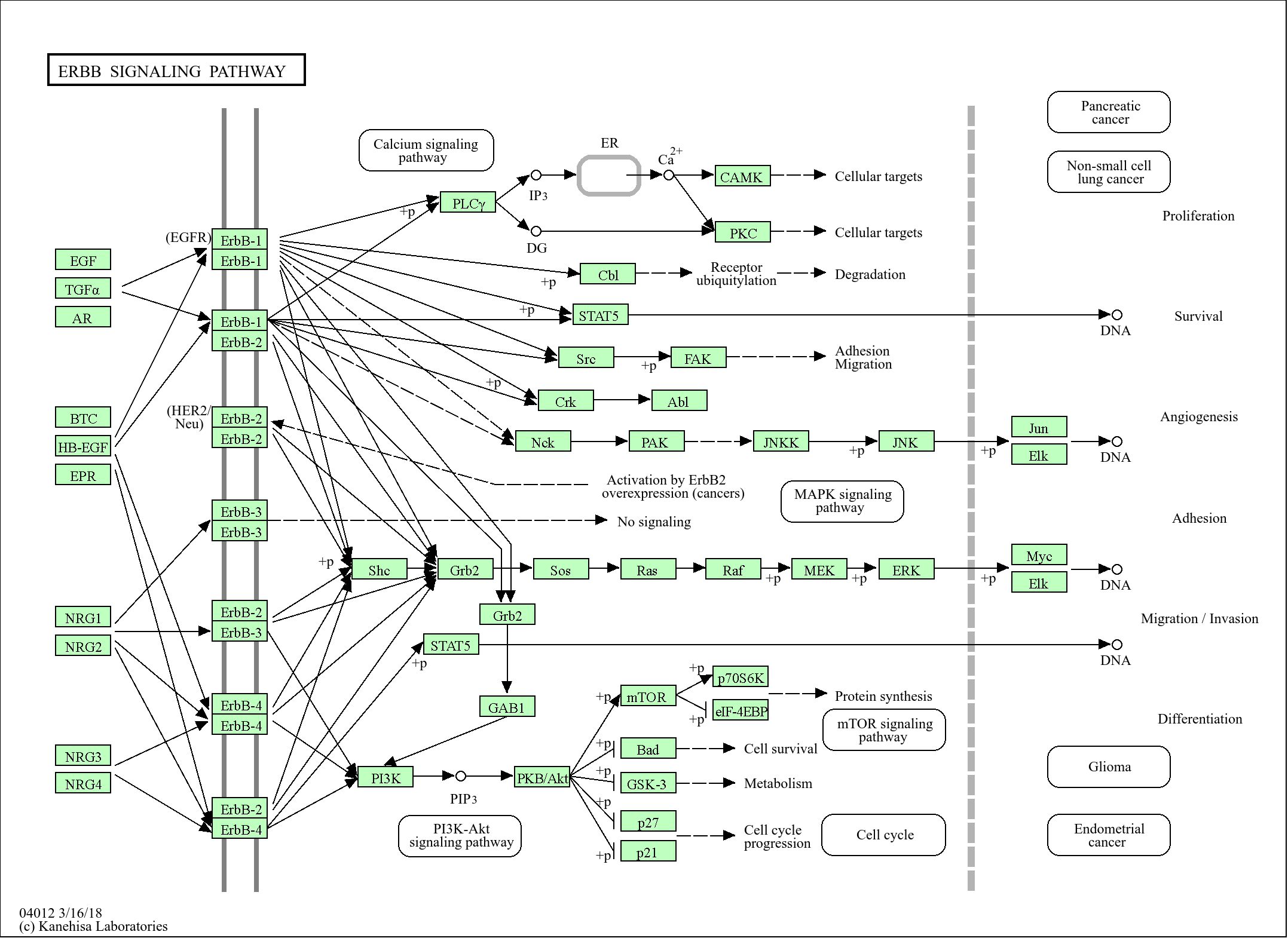
Cellular Processes >> Cell growth and death >> Cellular senescence
Cellular Processes >> Cellular community - eukaryotes >> Adherens junction
Organismal Systems >> Immune system >> Th17 cell differentiation
Organismal Systems >> Endocrine system >> Relaxin signaling pathway
Organismal Systems >> Development and regeneration >> Osteoclast differentiation
Human Diseases >> Cancer: overview >> Pathways in cancer
Human Diseases >> Cancer: overview >> Transcriptional misregulation in cancer
Human Diseases >> Cancer: specific types >> Colorectal cancer
Human Diseases >> Cancer: specific types >> Pancreatic cancer
Human Diseases >> Cancer: specific types >> Hepatocellular carcinoma
Human Diseases >> Cancer: specific types >> Gastric cancer
Human Diseases >> Cancer: specific types >> Chronic myeloid leukemia
Environmental Information Processing >> Signal transduction >> MAPK signaling pathway
Environmental Information Processing >> Signal transduction >> TGF-beta signaling pathway
Environmental Information Processing >> Signal transduction >> Hippo signaling pathway
Environmental Information Processing >> Signal transduction >> FoxO signaling pathway
Environmental Information Processing >> Signaling molecules and interaction >> Cytokine-cytokine receptor interaction
文献引用({{totalcount}})
货号: YM8220
规格
价格
货期
数量
200μL
¥3,580.00
现货
0
100μL
¥1,960.00
现货
0
40μL
¥960.00
现货
0
加入购物车
已收藏
收藏
Recently Viewed Products
Clear all


×

Toggle night Mode
{{pinfoXq.title || ''}}
Catalog: {{pinfoXq.catalog || ''}}
Filter:
All
{{item.name}}
{{pinfo.title}}
-{{pinfo.catalog}}
主要信息
Target
{{pinfo.target}}
Reactivity
{{pinfo.react}}
Applications
{{pinfo.applicat}}
Conjugate/Modification
{{pinfo.coupling}}/{{pinfo.modific}}
MW (kDa)
{{pinfo.mwcalc}}
Host Species
{{pinfo.hostspec}}
Isotype
{{pinfo.isotype}}
产品 {{index}}/{{pcount}}
上一个产品
下一个产品
{{pvTitle}}
滚轮缩放图片
{{pvDescr}}