



Cytokeratin 14 (ABT047) Mouse mAb
-YM6161



主要信息
Target
Cytokeratin 14
Host Species
Mouse
Reactivity
Human, Mouse, Rat
Applications
IHC, ELISA
MW
52kD (Calculated)
53kD (Observed)
Conjugate/Modification
Unmodified
货号: YM6161
规格
价格
货期
数量
200μL
¥3,780.00
现货
0
100μL
¥2,300.00
现货
0
40μL
¥960.00
现货
0
加入购物车


已收藏
收藏
详细信息
推荐稀释比
IHC 1:200-400; ELISA 1:500-5000
组成
PBS, 50% glycerol, 0.05% Proclin 300, 0.05%BSA
特异性
The antibody can specifically recognize human CK14 protein. In immunohistochemistry on formalin-fixed, paraffin-embedded tissue sections, the antibody specifically labels the basal cell of squamous epithelial cells and glandular epithelia, myoepithelium and mesothelial cells.
纯化工艺
The antibody was affinity-purified from ascites by affinity-chromatography using specific immunogen.
储存
-15°C to -25°C/1 year (Do not lower than -25°C)
理论分子量
52kD
实测条带
53kD
修饰
Unmodified
克隆性
Monoclonal
克隆号
ABT047
同种型
Mouse IgG2b/Kappa
相关产品
Secondary Antibodies
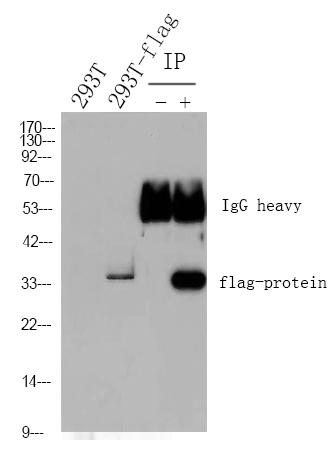
Goat Anti Mouse IgG(H+L) (HRP)
RS0001
预览→
Secondary Antibodies
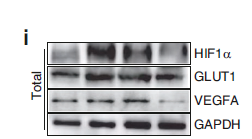
Goat Anti Rabbit IgG(H+L) (HRP)
RS0002
预览→
Primary Antibodies
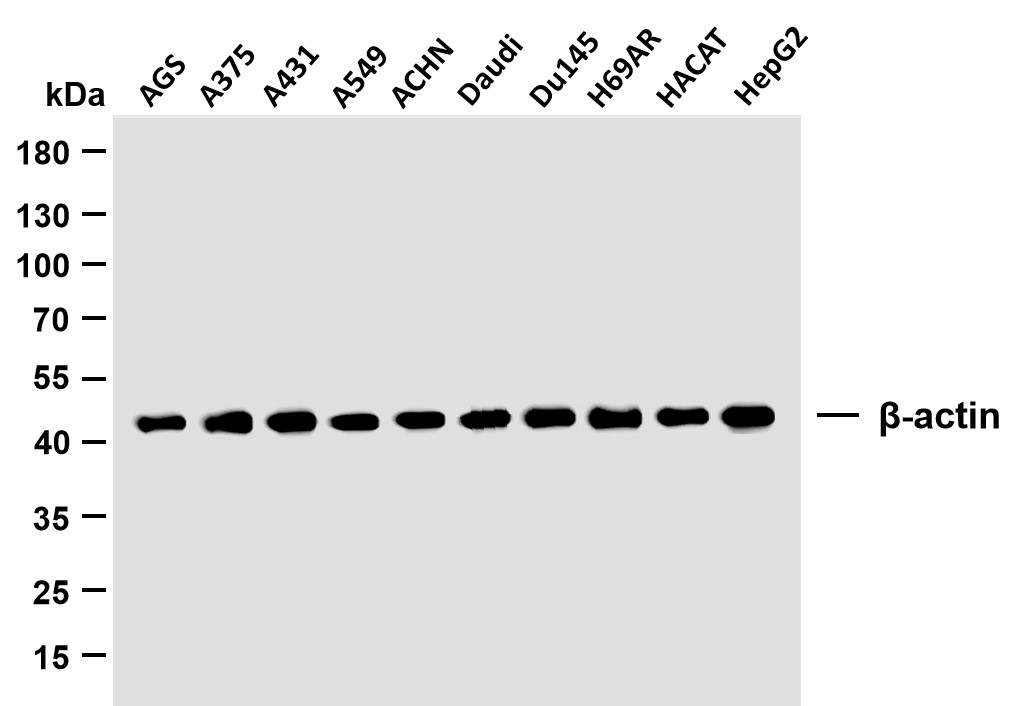
β-actin (PTR2364) Mouse mAb
YM3028
预览→
Primary Antibodies
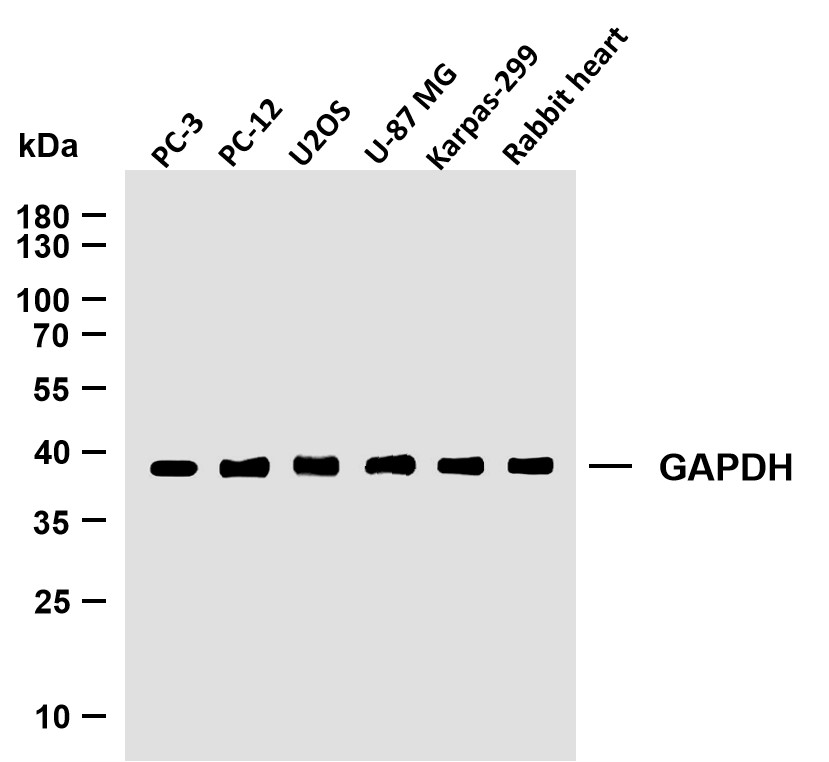
GAPDH (PTR2304) Mouse mAb
YM3029
预览→
抗原&靶点信息
免疫原:
Synthesized peptide derived from human CK14 AA range: 400-472
展开内容
特异性:
The antibody can specifically recognize human CK14 protein. In immunohistochemistry on formalin-fixed, paraffin-embedded tissue sections, the antibody specifically labels the basal cell of squamous epithelial cells and glandular epithelia, myoepithelium and mesothelial cells.
展开内容
基因名称:
KRT14
展开内容
蛋白名称:
Cytokeratin-14
展开内容
别名:
Keratin,type I cytoskeletal 14 ;
Cytokeratin-14 ;
CK-14 ;
Keratin-14 ;
K14 ;
Cytokeratin-14 ;
CK-14 ;
Keratin-14 ;
K14 ;
展开内容
背景:
This gene encodes a member of the keratin family , the most diverse group of intermediate filaments. This gene product , a type I keratin , is usually found as a heterotetramer with two keratin 5 molecules , a type II keratin. Together they form the cytoskeleton of epithelial cells. Mutations in the genes for these keratins are associated with epidermolysis bullosa simplex. At least one pseudogene has been identified at 17p12-p11. [provided by RefSeq , Jul 2008] ,
展开内容
功能:
Disease:Defects in KRT14 are a cause of epidermolysis bullosa simplex Dowling-Meara type (DM-EBS) [MIM:131760]. DM-EBS is a severe form of intraepidermal epidermolysis bullosa characterized by generalized herpetiform blistering , milia formation , dystrophic nails , and mucous membrane involvement. ,Disease:Defects in KRT14 are a cause of epidermolysis bullosa simplex Koebner type (K-EBS) [MIM:131900]. K-EBS is a form of intraepidermal epidermolysis bullosa characterized by generalized skin blistering. The phenotype is not fundamentally distinct from the Dowling-Meara type , althought it is less severe. ,Disease:Defects in KRT14 are a cause of epidermolysis bullosa simplex Weber-Cockayne type (WC-EBS) [MIM:131800]. WC-EBS is a form of intraepidermal epidermolysis bullosa characterized by blistering limited to palmar and plantar areas of the skin. ,Disease:Defects in KRT14 are the cause of dermatopathia pigmentosa reticularis (DPR) [MIM:125595]. DPR is a rare ectodermal dysplasia characterized by lifelong persistant reticulate hyperpigmentation , noncicatricial alopecia , and nail dystrophy. ,Disease:Defects in KRT14 are the cause of epidermolysis bullosa simplex autosomal recessive (AREBS) [MIM:601001]. AREBS is an intraepidermal epidermolysis bullosa characterized by localized blistering on the dorsal , lateral and plantar surfaces of the feet. ,Disease:Defects in KRT14 are the cause of Naegeli-Franceschetti-Jadassohn syndrome (NFJS) [MIM:161000]; also known as Naegeli syndrome. NFJS is a rare autosomal dominant form of ectodermal dysplasia. The cardinal features are absence of dermatoglyphics (fingerprints) , reticular cutaneous hyperpigmentation (starting at about the age of 2 years without a preceding inflammatory stage) , palmoplantar keratoderma , hypohidrosis with diminished sweat gland function and discomfort provoked by heat , nail dystrophy , and tooth enamel defects. ,Function:The nonhelical tail domain is involved in promoting KRT5-KRT14 filaments to self-organize into large bundles and enhances the mechanical properties involved in resilience of keratin intermediate filaments in vitro. ,miscellaneous:There are two types of cytoskeletal and microfibrillar keratin: I (acidic; 40-55 kDa) and II (neutral to basic; 56-70 kDa) . ,similarity:Belongs to the intermediate filament family. ,subcellular location:Expressed in both as a filamentous pattern. ,subunit:Heterotetramer of two type I and two type II keratins. keratin-14 associates with keratin-5. Interacts with TRADD and with keratin filaments. Associates with other type I keratins. ,tissue specificity:Detected in the basal layer , lowered within the more apically located layers specifically in the stratum spinosum , stratum granulosum but is not detected in stratum corneum. Strongly expressed in the outer root sheath of anagen follicles but not in the germinative matrix , inner root sheath or hair. Found in keratinocytes surrounding the club hair during telogen. ,
展开内容
细胞定位:
Cytoplasmic , Membranous
展开内容
研究领域:
>>Estrogen signaling pathway ;
>>Staphylococcus aureus infection
>>Staphylococcus aureus infection
展开内容
文献引用({{totalcount}})
货号: YM6161
规格
价格
货期
数量
200μL
¥3,780.00
现货
0
100μL
¥2,300.00
现货
0
40μL
¥960.00
现货
0
加入购物车
已收藏
收藏
Recently Viewed Products
Clear all


×

Toggle night Mode
{{pinfoXq.title || ''}}
Catalog: {{pinfoXq.catalog || ''}}
Filter:
All
{{item.name}}
{{pinfo.title}}
-{{pinfo.catalog}}
主要信息
Target
{{pinfo.target}}
Reactivity
{{pinfo.react}}
Applications
{{pinfo.applicat}}
Conjugate/Modification
{{pinfo.coupling}}/{{pinfo.modific}}
MW (kDa)
{{pinfo.mwcalc}}
Host Species
{{pinfo.hostspec}}
Isotype
{{pinfo.isotype}}
产品 {{index}}/{{pcount}}
上一个产品
下一个产品
{{pvTitle}}
滚轮缩放图片
{{pvDescr}}