



PPAR-γ (Phospho Ser112) Rabbit pAb
-YP0316




主要信息
Target
PPAR-γ Phospho Ser112
Host Species
Rabbit
Reactivity
Human, Mouse, Rat
Applications
WB, ELISA
MW
60kD (Observed)
Conjugate/Modification
Phospho
货号: YP0316
规格
价格
货期
数量
200μL
¥4,680.00
现货
0
100μL
¥2,800.00
现货
0
50μL
¥1,500.00
现货
0
加入购物车


已收藏
收藏
详细信息
推荐稀释比
WB 1:500-1:2000; ELISA 1:10000; Not yet tested in other applications.
组成
Liquid in PBS containing 50% glycerol, 0.5% BSA and 0.02% sodium azide.
特异性
Phospho-PPAR-γ (S112) Polyclonal Antibody detects endogenous levels of PPAR-γ protein only when phosphorylated at S112.The name of modified sites may be influenced by many factors, such as species (the modified site was not originally found in human samples) and the change of protein sequence (the previous protein sequence is incomplete, and the protein sequence may be prolonged with the development of protein sequencing technology). When naming, we will use the "numbers" in historical reference to keep the sites consistent with the reports. The antibody binds to the following modification sequence (lowercase letters are modification sites):PAsPP
纯化工艺
The antibody was affinity-purified from rabbit antiserum by affinity-chromatography using epitope-specific immunogen.
储存
-15°C to -25°C/1 year(Do not lower than -25°C)
浓度
1 mg/ml
实测条带
60kD
修饰
Phospho
克隆性
Polyclonal
同种型
IgG
相关产品
Primary Antibodies

PPAR-γ Rabbit pAb
YT3836
预览→
Primary Antibodies
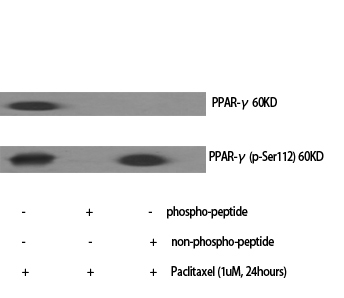
PPAR-γ (Phospho Ser112) Rabbit pAb
YP0316
预览→
ELISA Kits
Total PPAR-γ Cell-Based Colorimetric ELISA Kit
KA4252C
预览→
ELISA Kits
PPAR-γ (Phospho Ser112) Cell-Based Colorimetric ELISA Kit
KA1326C
预览→
抗原&靶点信息
免疫原:
The antiserum was produced against synthesized peptide derived from human PPAR-gamma around the phosphorylation site of Ser112. AA range:78-127
展开内容
特异性:
Phospho-PPAR-γ (S112) Polyclonal Antibody detects endogenous levels of PPAR-γ protein only when phosphorylated at S112.The name of modified sites may be influenced by many factors, such as species (the modified site was not originally found in human samples) and the change of protein sequence (the previous protein sequence is incomplete, and the protein sequence may be prolonged with the development of protein sequencing technology). When naming, we will use the "numbers" in historical reference to keep the sites consistent with the reports. The antibody binds to the following modification sequence (lowercase letters are modification sites):PAsPP
展开内容
基因名称:
PPARG
展开内容
蛋白名称:
Peroxisome proliferator-activated receptor gamma
展开内容
别名:
PPARG ;
NR1C3 ;
Peroxisome proliferator-activated receptor gamma ;
PPAR-gamma ;
Nuclear receptor subfamily 1 group C member 3
NR1C3 ;
Peroxisome proliferator-activated receptor gamma ;
PPAR-gamma ;
Nuclear receptor subfamily 1 group C member 3
展开内容
背景:
peroxisome proliferator activated receptor gamma(PPARG) Homo sapiens This gene encodes a member of the peroxisome proliferator-activated receptor (PPAR) subfamily of nuclear receptors. PPARs form heterodimers with retinoid X receptors (RXRs) and these heterodimers regulate transcription of various genes. Three subtypes of PPARs are known: PPAR-alpha, PPAR-delta, and PPAR-gamma. The protein encoded by this gene is PPAR-gamma and is a regulator of adipocyte differentiation. Additionally, PPAR-gamma has been implicated in the pathology of numerous diseases including obesity, diabetes, atherosclerosis and cancer. Alternatively spliced transcript variants that encode different isoforms have been described. [provided by RefSeq, Jul 2008],
展开内容
功能:
Alternative products:Additional isoforms seem to exist,Disease:Defects in PPARG are the cause of familial partial lipodystrophy type 3 (FPLD3) [MIM:604367]. Familial partial lipodystrophies (FPLD) are a heterogeneous group of genetic disorders characterized by marked loss of subcutaneous (sc) fat from the extremities. Affected individuals show an increased preponderance of insulin resistance, diabetes mellitus and dyslipidemia.,Disease:Defects in PPARG can lead to type 2 insulin-resistant diabetes and hyptertension.,Disease:Defects in PPARG may be associated with colon cancer.,Disease:Defects in PPARG may be associated with susceptibility to obesity [MIM:601665].,Disease:Variation in PPARG is associated with carotid intimal medial thickness 1 (CIMT1) [MIM:609338]. CIMT is a measure of atherosclerosis that is independently associated with traditional atherosclerotic cardiovascular disease risk factors and coronary atherosclerotic burden. 35 to 45% of the variability in multivariable-adjusted CIMT is explained by genetic factors.,Function:Receptor that binds peroxisome proliferators such as hypolipidemic drugs and fatty acids. Once activated by a ligand, the receptor binds to a promoter element in the gene for acyl-CoA oxidase and activates its transcription. It therefore controls the peroxisomal beta-oxidation pathway of fatty acids. Key regulator of adipocyte differentiation and glucose homeostasis.,online information:Peroxisome proliferator-activated receptor entry,online information:The Singapore human mutation and polymorphism database,polymorphism:Genetic variation in PPARG may influence body mass index (BMI) [MIM:606641]. BMI reflects the amount of fat, lean mass, and body build.,similarity:Belongs to the nuclear hormone receptor family.,similarity:Belongs to the nuclear hormone receptor family. NR1 subfamily.,similarity:Contains 1 nuclear receptor DNA-binding domain.,subunit:Forms a heterodimer with the retinoic acid receptor RXRA called adipocyte-specific transcription factor ARF6. Interacts with NCOA6 coactivator, leading to a strong increase in transcription of target genes. Interacts with coactivator PPARBP, leading to a mild increase in transcription of target genes. Interacts with FAM120B (By similarity). Interacts with NOCA7 in a ligand-inducible manner. Interacts with NCOA1 LXXLL motifs. Interacts with TGFB1I1. Interacts with DNTTIP2.,tissue specificity:Highest expression in adipose tissue. Lower in skeletal muscle, spleen, heart and liver. Also detectable in placenta, lung and ovary.,
展开内容
细胞定位:
Nucleus. Cytoplasm. Redistributed from the nucleus to the cytosol through a MAP2K1/MEK1-dependent manner. NOCT enhances its nuclear translocation.
展开内容
研究领域:
>>PPAR signaling pathway ;
>>AMPK signaling pathway ;
>>Longevity regulating pathway ;
>>Osteoclast differentiation ;
>>Thermogenesis ;
>>Non-alcoholic fatty liver disease ;
>>Huntington disease ;
>>Pathways in cancer ;
>>Transcriptional misregulation in cancer ;
>>Thyroid cancer ;
>>Lipid and atherosclerosis
>>AMPK signaling pathway ;
>>Longevity regulating pathway ;
>>Osteoclast differentiation ;
>>Thermogenesis ;
>>Non-alcoholic fatty liver disease ;
>>Huntington disease ;
>>Pathways in cancer ;
>>Transcriptional misregulation in cancer ;
>>Thyroid cancer ;
>>Lipid and atherosclerosis
展开内容
信号通路
Organismal Systems >> Endocrine system >> PPAR signaling pathway
Organismal Systems >> Development and regeneration >> Osteoclast differentiation
Organismal Systems >> Aging >> Longevity regulating pathway
Human Diseases >> Cancer: overview >> Pathways in cancer
Human Diseases >> Cancer: overview >> Transcriptional misregulation in cancer
Human Diseases >> Cancer: specific types >> Thyroid cancer
Human Diseases >> Neurodegenerative disease >> Huntington disease
Environmental Information Processing >> Signal transduction >> AMPK signaling pathway
文献引用({{totalcount}})
货号: YP0316
规格
价格
货期
数量
200μL
¥4,680.00
现货
0
100μL
¥2,800.00
现货
0
50μL
¥1,500.00
现货
0
加入购物车
已收藏
收藏
Recently Viewed Products
Clear all


Toggle night Mode
{{pinfoXq.title || ''}}
Catalog: {{pinfoXq.catalog || ''}}
Filter:
All
{{item.name}}
{{pinfo.title}}
-{{pinfo.catalog}}
主要信息
Target
{{pinfo.target}}
Reactivity
{{pinfo.react}}
Applications
{{pinfo.applicat}}
Conjugate/Modification
{{pinfo.coupling}}/{{pinfo.modific}}
MW (kDa)
{{pinfo.mwcalc}}
Host Species
{{pinfo.hostspec}}
Isotype
{{pinfo.isotype}}
产品 {{index}}/{{pcount}}
上一个产品
下一个产品
{{pvTitle}}
滚轮缩放图片
{{pvDescr}}