



ATP5A (PT0255R) PT™ Rabbit mAb
-YM8161






主要信息
Target
ATP5A
Host Species
Rabbit
Reactivity
Human, Mouse, Rat
Applications
WB, IHC, IF, ELISA
MW
60kD (Calculated)
55kD (Observed)
Conjugate/Modification
Unmodified
货号: YM8161
规格
价格
货期
数量
200μL
¥3,580.00
现货
0
100μL
¥1,960.00
现货
0
40μL
¥960.00
现货
0
加入购物车


已收藏
收藏
详细信息
推荐稀释比
IHC 1:200-1:1000; WB 1:2000-1:10000; IF 1:200-1:1000; ELISA 1:5000-1:20000;
组成
PBS, 50% glycerol, 0.05% Proclin 300, 0.05%BSA
特异性
Endogenous
纯化工艺
Protein A
储存
-15°C to -25°C/1 year(Do not lower than -25°C)
理论分子量
60kD
实测条带
55kD
修饰
Unmodified
克隆性
Monoclonal
克隆号
PT0255R
同种型
IgG,Kappa
相关产品
Secondary Antibodies
Goat Anti Mouse IgG(H+L) (HRP)
RS0001
预览→
Secondary Antibodies
Goat Anti Rabbit IgG(H+L) (HRP)
RS0002
预览→
Primary Antibodies
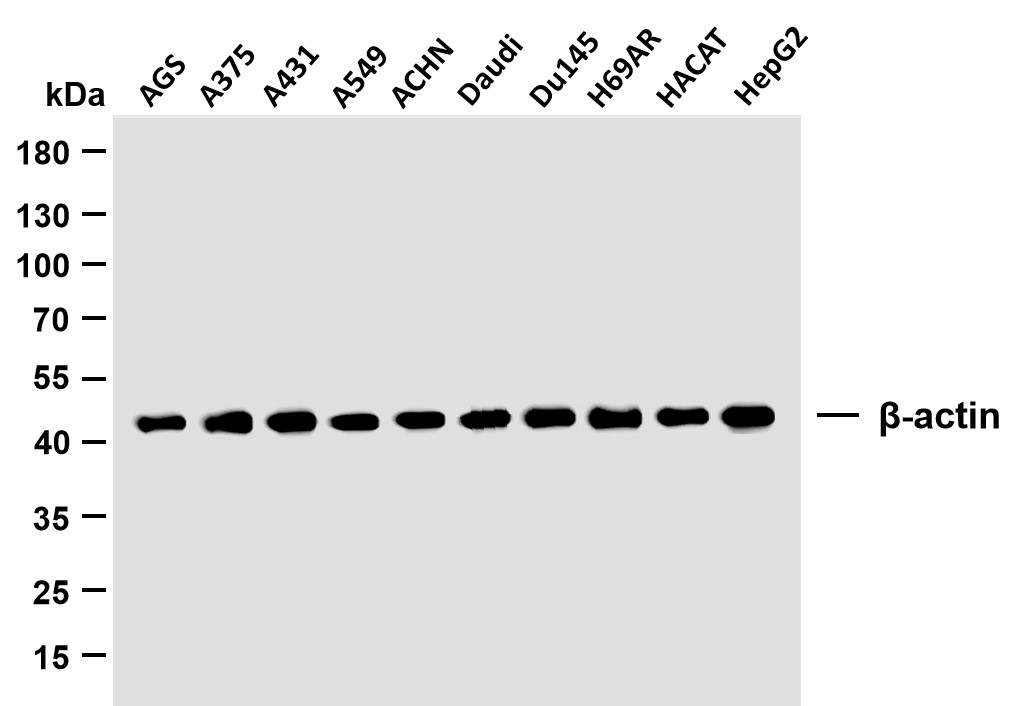
β-actin (PTR2364) Mouse mAb
YM3028
预览→
Primary Antibodies
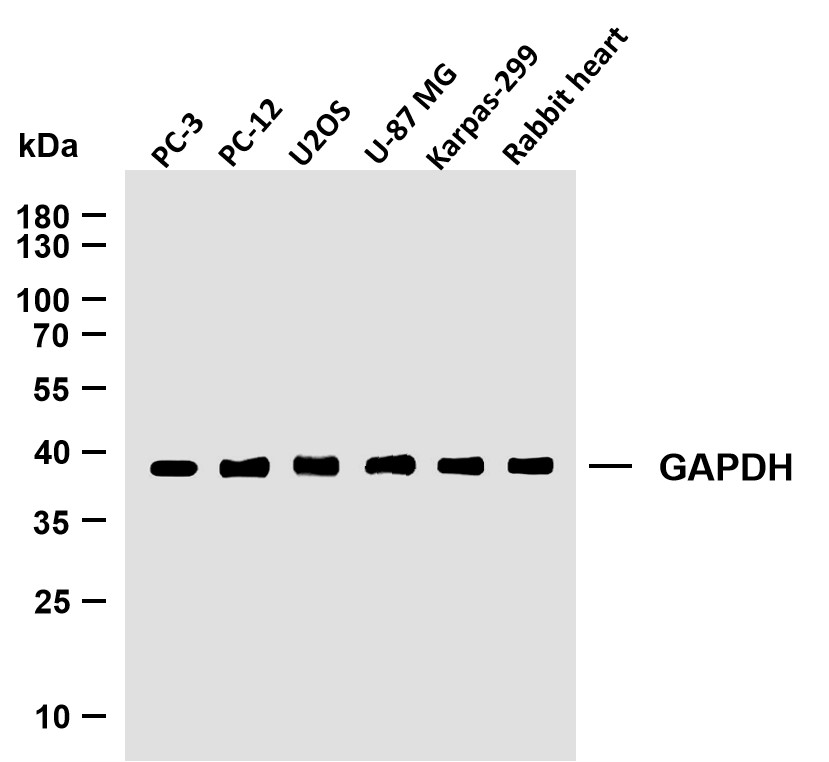
GAPDH (PTR2304) Mouse mAb
YM3029
预览→
抗原&靶点信息
特异性:
Endogenous
展开内容
基因名称:
ATP5A1
展开内容
蛋白名称:
ATP synthase subunit alpha mitochondrial
展开内容
别名:
ATP5A1 ;
ATP5A ;
ATP5AL2 ;
ATPM ;
ATP synthase subunit alpha ;
mitochondrial
ATP5A ;
ATP5AL2 ;
ATPM ;
ATP synthase subunit alpha ;
mitochondrial
展开内容
背景:
This gene encodes a subunit of mitochondrial ATP synthase. Mitochondrial ATP synthase catalyzes ATP synthesis, using an electrochemical gradient of protons across the inner membrane during oxidative phosphorylation. ATP synthase is composed of two linked multi-subunit complexes: the soluble catalytic core, F1, and the membrane-spanning component, Fo, comprising the proton channel. The catalytic portion of mitochondrial ATP synthase consists of 5 different subunits (alpha, beta, gamma, delta, and epsilon) assembled with a stoichiometry of 3 alpha, 3 beta, and a single representative of the other 3. The proton channel consists of three main subunits (a, b, c). This gene encodes the alpha subunit of the catalytic core. Alternatively spliced transcript variants encoding the different isoforms have been identified. Pseudogenes of thi
展开内容
功能:
Function:Mitochondrial membrane ATP synthase (F(1)F(0) ATP synthase or Complex V) produces ATP from ADP in the presence of a proton gradient across the membrane which is generated by electron transport complexes of the respiratory chain. F-type ATPases consist of two structural domains, F(1) - containing the extramembraneous catalytic core, and F(0) - containing the membrane proton channel, linked together by a central stalk and a peripheral stalk. During catalysis, ATP synthesis in the catalytic domain of F(1) is coupled via a rotary mechanism of the central stalk subunits to proton translocation. Subunits alpha and beta form the catalytic core in F(1). Rotation of the central stalk against the surrounding alpha(3)beta(3) subunits leads to hydrolysis of ATP in three separate catalytic sites on the beta subunits. Subunit alpha does not bear the catalytic high-affinity ATP-binding sites.,PTM:The N-terminus is blocked.,similarity:Belongs to the ATPase alpha/beta chains family.,subcellular location:Peripheral membrane protein.,subunit:F-type ATPases have 2 components, CF(1) - the catalytic core - and CF(0) - the membrane proton channel. CF(1) has five subunits: alpha(3), beta(3), gamma(1), delta(1), epsilon(1). CF(0) has three main subunits: a, b and c. Interacts with ATPAF2.,tissue specificity:Fetal lung, heart, liver, gut and kidney. Expressed at higher levels in the fetal brain, retina and spinal cord.,
展开内容
细胞定位:
Mitochondrion
展开内容
研究领域:
>>Oxidative phosphorylation ;
>>Metabolic pathways ;
>>Thermogenesis ;
>>Alzheimer disease ;
>>Parkinson disease ;
>>Amyotrophic lateral sclerosis ;
>>Huntington disease ;
>>Prion disease ;
>>Pathways of neurodegeneration - multiple diseases ;
>>Chemical carcinogenesis - reactive oxygen species ;
>>Diabetic cardiomyopathy
>>Metabolic pathways ;
>>Thermogenesis ;
>>Alzheimer disease ;
>>Parkinson disease ;
>>Amyotrophic lateral sclerosis ;
>>Huntington disease ;
>>Prion disease ;
>>Pathways of neurodegeneration - multiple diseases ;
>>Chemical carcinogenesis - reactive oxygen species ;
>>Diabetic cardiomyopathy
展开内容
信号通路
Human Diseases >> Neurodegenerative disease >> Alzheimer disease
Human Diseases >> Neurodegenerative disease >> Parkinson disease
Human Diseases >> Neurodegenerative disease >> Amyotrophic lateral sclerosis
Human Diseases >> Neurodegenerative disease >> Huntington disease
Human Diseases >> Neurodegenerative disease >> Prion disease
Human Diseases >> Neurodegenerative disease >> Pathways of neurodegeneration - multiple diseases
文献引用({{totalcount}})
货号: YM8161
规格
价格
货期
数量
200μL
¥3,580.00
现货
0
100μL
¥1,960.00
现货
0
40μL
¥960.00
现货
0
加入购物车
已收藏
收藏
Recently Viewed Products
Clear all


×

Toggle night Mode
{{pinfoXq.title || ''}}
Catalog: {{pinfoXq.catalog || ''}}
Filter:
All
{{item.name}}
{{pinfo.title}}
-{{pinfo.catalog}}
主要信息
Target
{{pinfo.target}}
Reactivity
{{pinfo.react}}
Applications
{{pinfo.applicat}}
Conjugate/Modification
{{pinfo.coupling}}/{{pinfo.modific}}
MW (kDa)
{{pinfo.mwcalc}}
Host Species
{{pinfo.hostspec}}
Isotype
{{pinfo.isotype}}
产品 {{index}}/{{pcount}}
上一个产品
下一个产品
{{pvTitle}}
滚轮缩放图片
{{pvDescr}}