
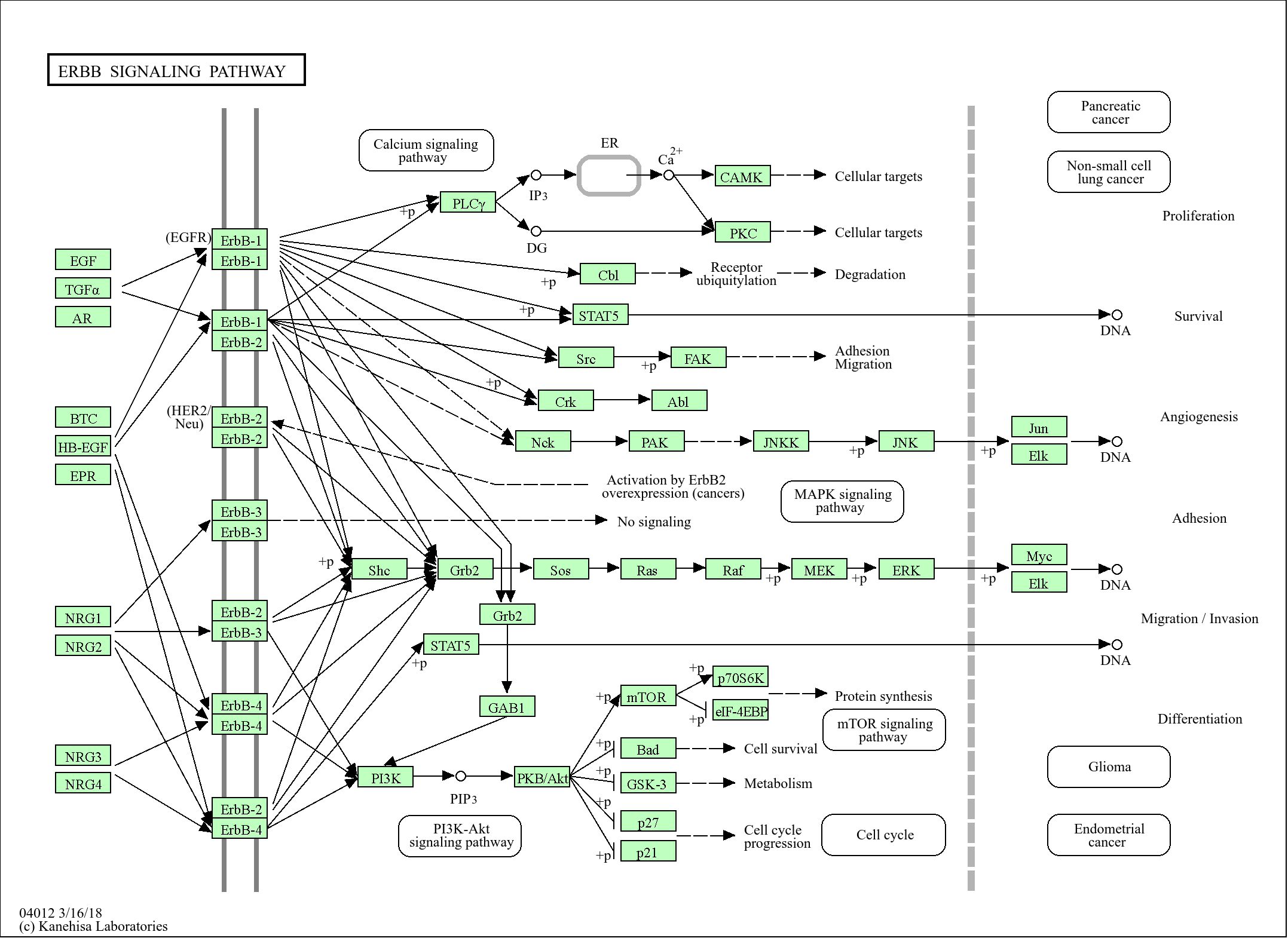


STAT3 (Phospho Ser754) Rabbit pAb
-YP1513



主要信息
Target
Stat3 Phospho Ser754
Host Species
Rabbit
Reactivity
Human, Mouse
Applications
WB, IHC
MW
88kD (Observed)
Conjugate/Modification
phosphate
货号: YP1513
规格
价格
货期
数量
200μL
¥4,680.00
现货
0
100μL
¥2,800.00
现货
0
50μL
¥1,500.00
现货
0
加入购物车


已收藏
收藏
详细信息
推荐稀释比
WB 1:500-2000; IHC 1:50-300
组成
Liquid in PBS containing 50% glycerol, 0.5% BSA and 0.02% sodium azide.
特异性
This antibody detects endogenous levels of Human Mouse Stat3 (phospho-Ser754)
纯化工艺
The antibody was affinity-purified from rabbit serum by affinity-chromatography using specific immunogen.
储存
-15°C to -25°C/1 year (Do not lower than -25°C)
浓度
1 mg/ml
实测条带
88kD
修饰
phosphate
克隆性
Polyclonal
同种型
IgG
相关产品
Primary Antibodies

STAT3 Rabbit pAb
YT4443
预览→
Primary Antibodies
STAT3 (Phospho Tyr705) Rabbit pAb
YP0251
预览→
Primary Antibodies
.jpg)
STAT3 (Phospho Ser727) Rabbit pAb
YP0250
预览→
Primary Antibodies
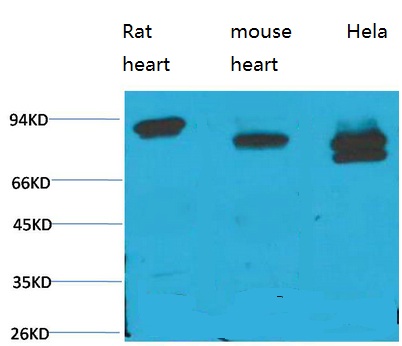
STAT3 (PTR1364) Mouse mAb
YM3507
预览→
Primary Antibodies
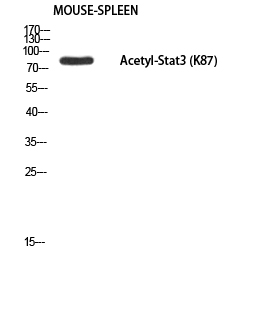
STAT3 (Acetyl Lys87) Rabbit pAb
YK0070
预览→
ELISA Kits
Total STAT3 Cell-Based Colorimetric ELISA Kit
KA3182C
预览→
ELISA Kits
Total STAT3 Cell-Based Colorimetric ELISA Kit
KA3181C
预览→
ELISA Kits
Total STAT3 Cell-Based Colorimetric ELISA Kit
KA3180C
预览→
ELISA Kits
STAT3 (Phospho Tyr705) Cell-Based Colorimetric ELISA Kit
KA1148C
预览→
ELISA Kits
STAT3 (Phospho Ser727) Cell-Based Colorimetric ELISA Kit
KA1147C
预览→
抗原&靶点信息
免疫原:
Synthesized phosho peptide around human Stat3 (Ser754)
展开内容
特异性:
This antibody detects endogenous levels of Human Mouse Stat3 (phospho-Ser754)
展开内容
基因名称:
STAT3 APRF
展开内容
蛋白名称:
Stat3 (Ser754)
展开内容
别名:
STAT3 ;
APRF ;
Signal transducer and activator of transcription 3 ;
Acute-phase response factor
APRF ;
Signal transducer and activator of transcription 3 ;
Acute-phase response factor
展开内容
背景:
The protein encoded by this gene is a member of the STAT protein family. In response to cytokines and growth factors , STAT family members are phosphorylated by the receptor associated kinases , and then form homo- or heterodimers that translocate to the cell nucleus where they act as transcription activators. This protein is activated through phosphorylation in response to various cytokines and growth factors including IFNs , EGF , IL5 , IL6 , HGF , LIF and BMP2. This protein mediates the expression of a variety of genes in response to cell stimuli , and thus plays a key role in many cellular processes such as cell growth and apoptosis. The small GTPase Rac1 has been shown to bind and regulate the activity of this protein. PIAS3 protein is a specific inhibitor of this protein. Mutations in this gene are associated with infantile-onset multisystem autoimmune disease and hyper
展开内容
功能:
Disease:Defects in STAT3 are the cause of hyperimmunoglobulin E recurrent infection syndrome autosomal dominant (AD-HIES) [MIM:147060]; also known as hyper-IgE syndrome or Job syndrome. AD-HIES is a rare disorder of immunity and connective tissue characterized by immunodeficiency , chronic eczema , recurrent Staphylococcal infections , increased serum IgE , eosinophilia , distinctive coarse facial appearance , abnormal dentition , hyperextensibility of the joints , and bone fractures. ,Function:Transcription factor that binds to the interleukin-6 (IL-6) -responsive elements identified in the promoters of various acute-phase protein genes. Activated by IL31 through IL31RA. ,miscellaneous:Involved in the gp130-mediated signaling pathway. ,online information:STAT3 entry ,online information:STAT3 mutation db ,PTM:Tyrosine phosphorylated in response to IL-6 , IL-11 , CNTF , LIF , CSF-1 , EGF , PDGF , IFN-alpha and OSM. Phosphorylated on serine upon DNA damage , probably by ATM or ATR. Serine phosphorylation is important for the formation of stable DNA-binding STAT3 homodimers and maximal transcriptional activity. ,similarity:Belongs to the transcription factor STAT family. ,similarity:Contains 1 SH2 domain. ,subcellular location:Shuttles between the nucleus and the cytoplasm. Constitutive nuclear presence is independent of tyrosine phosphorylation. ,subunit:Forms a homodimer or a heterodimer with a related family member (at least STAT1) . Interacts with NCOA1 , PELP1 , SOCS7 and STATIP1. Interacts with HCV core protein. Interacts with IL23R in presence of IL23. Interacts with IL31RA. Interacts with SIPAR. Interacts (via SH2 domain) with NLK (By similarity) . Interacts with KPNA4 and KPNA5; KPNA4 may be the primary mediator of nuclear import (By similarity) . Interacts with TMF1. ,tissue specificity:Heart , brain , placenta , lung , liver , skeletal muscle , kidney and pancreas. ,
展开内容
细胞定位:
Cytoplasm . Nucleus . Shuttles between the nucleus and the cytoplasm. Translocated into the nucleus upon tyrosine phosphorylation and dimerization , in response to signaling by activated FGFR1 , FGFR2 , FGFR3 or FGFR4. Constitutive nuclear presence is independent of tyrosine phosphorylation. Predominantly present in the cytoplasm without stimuli. Upon leukemia inhibitory factor (LIF) stimulation , accumulates in the nucleus. The complex composed of BART and ARL2 plays an important role in the nuclear translocation and retention of STAT3. Identified in a complex with LYN and PAG1.
展开内容
研究领域:
>>EGFR tyrosine kinase inhibitor resistance ;
>>Chemokine signaling pathway ;
>>HIF-1 signaling pathway ;
>>FoxO signaling pathway ;
>>Necroptosis ;
>>Signaling pathways regulating pluripotency of stem cells ;
>>JAK-STAT signaling pathway ;
>>Th17 cell differentiation ;
>>Prolactin signaling pathway ;
>>Adipocytokine signaling pathway ;
>>Insulin resistance ;
>>AGE-RAGE signaling pathway in diabetic complications ;
>>Growth hormone synthesis , secretion and action ;
>>Toxoplasmosis ;
>>Hepatitis C ;
>>Hepatitis B ;
>>Measles ;
>>Human cytomegalovirus infection ;
>>Kaposi sarcoma-associated herpesvirus infection ;
>>Epstein-Barr virus infection ;
>>Coronavirus disease - COVID-19 ;
>>Pathways in cancer ;
>>Viral carcinogenesis ;
>>Proteoglycans in cancer ;
>>MicroRNAs in cancer ;
>>Chemical carcinogenesis - receptor activation ;
>>Pancreatic cancer ;
>>Acute myeloid leukemia ;
>>Non-small cell lung cancer ;
>>PD-L1 expression and PD-1 checkpoint pathway in cancer ;
>>Inflammatory bowel disease ;
>>Lipid and atherosclerosis
>>Chemokine signaling pathway ;
>>HIF-1 signaling pathway ;
>>FoxO signaling pathway ;
>>Necroptosis ;
>>Signaling pathways regulating pluripotency of stem cells ;
>>JAK-STAT signaling pathway ;
>>Th17 cell differentiation ;
>>Prolactin signaling pathway ;
>>Adipocytokine signaling pathway ;
>>Insulin resistance ;
>>AGE-RAGE signaling pathway in diabetic complications ;
>>Growth hormone synthesis , secretion and action ;
>>Toxoplasmosis ;
>>Hepatitis C ;
>>Hepatitis B ;
>>Measles ;
>>Human cytomegalovirus infection ;
>>Kaposi sarcoma-associated herpesvirus infection ;
>>Epstein-Barr virus infection ;
>>Coronavirus disease - COVID-19 ;
>>Pathways in cancer ;
>>Viral carcinogenesis ;
>>Proteoglycans in cancer ;
>>MicroRNAs in cancer ;
>>Chemical carcinogenesis - receptor activation ;
>>Pancreatic cancer ;
>>Acute myeloid leukemia ;
>>Non-small cell lung cancer ;
>>PD-L1 expression and PD-1 checkpoint pathway in cancer ;
>>Inflammatory bowel disease ;
>>Lipid and atherosclerosis
展开内容
信号通路
Cellular Processes >> Cell growth and death >> Necroptosis
Cellular Processes >> Cellular community - eukaryotes >> Signaling pathways regulating pluripotency of stem cells
Organismal Systems >> Immune system >> Th17 cell differentiation
Organismal Systems >> Immune system >> Chemokine signaling pathway
Organismal Systems >> Endocrine system >> Adipocytokine signaling pathway
Organismal Systems >> Endocrine system >> Prolactin signaling pathway
Organismal Systems >> Endocrine system >> Growth hormone synthesis, secretion and action
Human Diseases >> Cancer: overview >> Pathways in cancer
Human Diseases >> Cancer: overview >> MicroRNAs in cancer
Human Diseases >> Cancer: overview >> PD-L1 expression and PD-1 checkpoint pathway in cancer
Human Diseases >> Cancer: specific types >> Pancreatic cancer
Human Diseases >> Cancer: specific types >> Acute myeloid leukemia
Human Diseases >> Cancer: specific types >> Non-small cell lung cancer
Human Diseases >> Immune disease >> Inflammatory bowel disease
Environmental Information Processing >> Signal transduction >> JAK-STAT signaling pathway
Environmental Information Processing >> Signal transduction >> HIF-1 signaling pathway
Environmental Information Processing >> Signal transduction >> FoxO signaling pathway
文献引用({{totalcount}})
货号: YP1513
规格
价格
货期
数量
200μL
¥4,680.00
现货
0
100μL
¥2,800.00
现货
0
50μL
¥1,500.00
现货
0
加入购物车
已收藏
收藏
Recently Viewed Products
Clear all


×

Toggle night Mode
{{pinfoXq.title || ''}}
Catalog: {{pinfoXq.catalog || ''}}
Filter:
All
{{item.name}}
{{pinfo.title}}
-{{pinfo.catalog}}
主要信息
Target
{{pinfo.target}}
Reactivity
{{pinfo.react}}
Applications
{{pinfo.applicat}}
Conjugate/Modification
{{pinfo.coupling}}/{{pinfo.modific}}
MW (kDa)
{{pinfo.mwcalc}}
Host Species
{{pinfo.hostspec}}
Isotype
{{pinfo.isotype}}
产品 {{index}}/{{pcount}}
上一个产品
下一个产品
{{pvTitle}}
滚轮缩放图片
{{pvDescr}}