


p63 (Phospho Ser160/162) Rabbit pAb
-YP1426



主要信息
Target
p40/p63 Phospho Ser160/162
Host Species
Rabbit
Reactivity
Human, Mouse, Rat
Applications
WB
MW
63kD (Observed)
Conjugate/Modification
phosphate

货号: YP1426
规格
价格
货期
数量
200μL
¥4,680.00
现货
0
100μL
¥2,800.00
现货
0
50μL
¥1,500.00
现货
0
加入购物车


已收藏
收藏
详细信息
推荐稀释比
WB 1:1000-2000
组成
Liquid in PBS containing 50% glycerol, 0.5% BSA and 0.02% sodium azide.
特异性
This antibody detects endogenous levels of p40/p63 only when phosphorylated at Ser160 or Ser162,and dually phosphorylated at two sites.
纯化工艺
The antibody was affinity-purified from rabbit serum by affinity-chromatography using specific immunogen.
储存
-15°C to -25°C/1 year (Do not lower than -25°C)
浓度
1 mg/ml
实测条带
63kD
修饰
phosphate
克隆性
Polyclonal
同种型
IgG
相关产品
Secondary Antibodies
Goat Anti Mouse IgG(H+L) (HRP)
RS0001
预览→
Secondary Antibodies
Goat Anti Rabbit IgG(H+L) (HRP)
RS0002
预览→
Primary Antibodies
β-actin (PTR2364) Mouse mAb
YM3028
预览→
Primary Antibodies
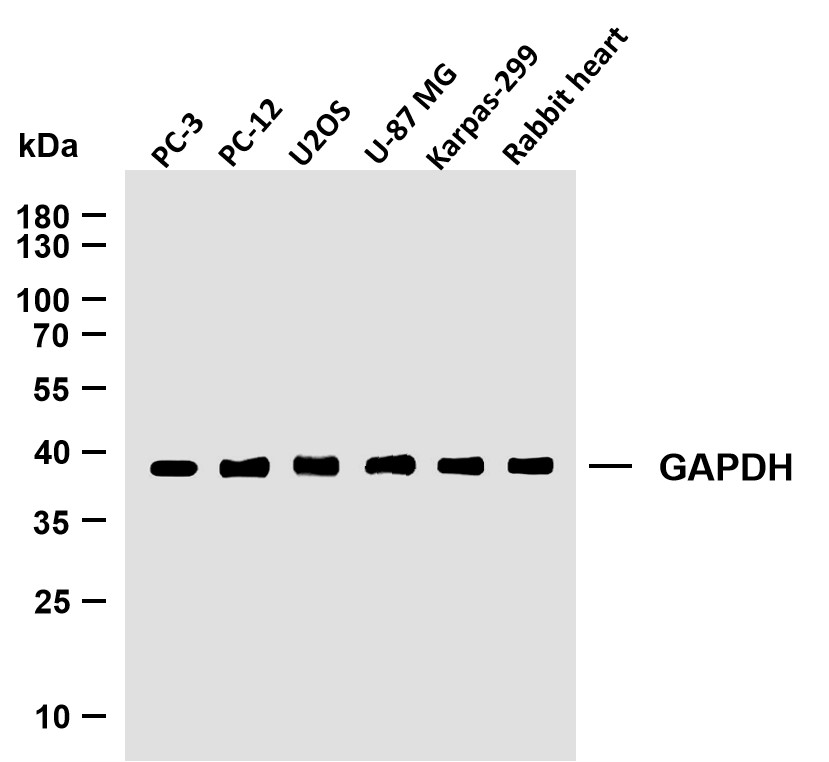
GAPDH (PTR2304) Mouse mAb
YM3029
预览→
抗原&靶点信息
免疫原:
Synthesized phosho peptide around human p63 (Ser160 and 162)
展开内容
特异性:
This antibody detects endogenous levels of p40/p63 only when phosphorylated at Ser160 or Ser162,and dually phosphorylated at two sites.
展开内容
基因名称:
TP63 KET P63 P73H P73L TP73L
展开内容
蛋白名称:
p63 (Ser160/162)
展开内容
别名:
Tumor protein 63 ;
p63 ;
Chronic ulcerative stomatitis protein ;
CUSP ;
Keratinocyte transcription factor KET ;
Transformation-related protein 63 ;
TP63 ;
Tumor protein p73-like ;
p73L ;
p40 ;
p51 ;
p63 ;
Chronic ulcerative stomatitis protein ;
CUSP ;
Keratinocyte transcription factor KET ;
Transformation-related protein 63 ;
TP63 ;
Tumor protein p73-like ;
p73L ;
p40 ;
p51 ;
展开内容
背景:
tumor protein p63 (TP63) Homo sapiens This gene encodes a member of the p53 family of transcription factors. The functional domains of p53 family proteins include an N-terminal transactivation domain , a central DNA-binding domain and an oligomerization domain. Alternative splicing of this gene and the use of alternative promoters results in multiple transcript variants encoding different isoforms that vary in their functional properties. These isoforms function during skin development and maintenance , adult stem/progenitor cell regulation , heart development and premature aging. Some isoforms have been found to protect the germline by eliminating oocytes or testicular germ cells that have suffered DNA damage. Mutations in this gene are associated with ectodermal dysplasia , and cleft lip/palate syndrome 3 (EEC3) ; split-hand/foot malformation 4 (SHFM4) ; ankyloblepharon-ectodermal defects-cleft lip/palate; ADULT syndrome (acro-dermato-ungual-lacrim
展开内容
功能:
cofactor:Binds 1 zinc ion per subunit. ,Disease:Defects in TP63 are a cause of cervical , colon , head and neck , lung and ovarian cancers. ,Disease:Defects in TP63 are a cause of ectodermal dysplasia Rapp-Hodgkin type (EDRH) [MIM:129400]; also called Rapp-Hodgkin syndrome or anhidrotic ectodermal dysplasia with cleft lip/palate. Ectodermal dysplasia defines a heterogeneous group of disorders due to abnormal development of two or more ectodermal structures. EDRH is characterized by the combination of anhidrotic ectodermal dysplasia , cleft lip , and cleft palate. The clinical syndrome is comprised of a characteristic facies (narrow nose and small mouth) , wiry , slow-growing , and uncombable hair , sparse eyelashes and eyebrows , obstructed lacrimal puncta/epiphora , bilateral stenosis of external auditory canals , microsomia , hypodontia , cone-shaped incisors , enamel hypoplasia , dystrophic nails , and cleft lip/cleft palate. ,Disease:Defects in TP63 are the cause of acro-dermato-ungual-lacrimal-tooth syndrome (ADULT syndrome) [MIM:103285]; a form of ectodermal dysplasia. Ectodermal dysplasias (EDs) constitute a heterogeneous group of developmental disorders affecting tissues of ectodermal origin. EDs are characterized by abnormal development of two or more ectodermal structures such as hair , teeth , nails and sweat glands , with or without any additional clinical sign. Each combination of clinical features represents a different type of ectodermal dysplasia. ADULT syndrome involves ectrodactyly , syndactyly , finger- and toenail dysplasia , hypoplastic breasts and nipples , intensive freckling , lacrimal duct atresia , frontal alopecia , primary hypodontia , and loss of permanent teeth. ADULT differs significantly from EEC3 syndrome by the absence of facial clefting. ,Disease:Defects in TP63 are the cause of ankyloblepharon-ectodermal defects-cleft lip/palate (AEC) [MIM:106260]. AEC is an autosomal dominant condition characterized by congenital ectodermal dysplasia with coarse , wiry , sparse hair , dystrophic nails , slight hypohidrosis , scalp infections , ankyloblepharon filiforme adnatum , maxillary hypoplasia , hypodontia and cleft lip/palate. ,Disease:Defects in TP63 are the cause of ectrodactyly-ectodermal dysplasia-cleft lip/palate syndrome type 3 (EEC3) [MIM:604292]. EEC3 is an autosomal dominant syndrome characterized by ectrodactyly of hands and feet , ectodermal dysplasia and facial clefting. ,Disease:Defects in TP63 are the cause of limb-mammary syndrome (LMS) [MIM:603543]. LMS is characterized by ectrodactyly , cleft palate and mammary-gland abnormalities. ,Disease:Defects in TP63 are the cause of non-syndromic orofacial cleft type 8 (OFC8) [MIM:129400]. Non-syndromic orofacial cleft is a common birth defect consisting of cleft lips with or without cleft palate. Cleft lips are associated with cleft palate in two-third of cases. A cleft lip can occur on one or both sides and range in severity from a simple notch in the upper lip to a complete opening in the lip extending into the floor of the nostril and involving the upper gum. ,Disease:Defects in TP63 are the cause of split-hand/foot malformation 4 (SHFM4) [MIM:605289]. Split-hand/split-foot malformation is a limb malformation involving the central rays of the autopod and presenting with syndactyly , median clefts of the hands and feet , and aplasia and/or hypoplasia of the phalanges , metacarpals , and metatarsals. There is restricted overlap between the mutational spectra of EEC3 and SHFM4. ,Domain:The transactivation inhibitory domain (TID) can interact with , and inhibit the activity of the N-terminal transcriptional activation domain of TA*-type isoforms. ,Function:Acts as a sequence specific DNA binding transcriptional activator or repressor. The isoforms contain a varying set of transactivation and auto-regulating transactivation inhibiting domains thus showing an isoform specific activity. May be required in conjunction with TP73/p73 for initiation of TP53/p53 dependent apoptosis in response to genotoxic insults and the presence of activated oncogenes. Involved in Notch signaling by probably inducing JAG1 and JAG2. Plays a role in the regulation of epithelial morphogenesis. The ratio of DeltaN-type and TA*-type isoforms may govern the maintenance of epithelial stem cell compartments and regulate the initiation of epithelial stratification from the undifferentiated embryonal ectoderm. Required for limb formation from the apical ectodermal ridge. ,PTM:May be sumoylated. ,similarity:Belongs to the p53 family. ,similarity:Contains 1 SAM (sterile alpha motif) domain. ,subunit:Binds DNA as a homotetramer. Isoform composition of the tetramer may determine transactivation activity. Isoforms Alpha and Gamma interact with HIPK2. Interacts with SSRP1 , leading to stimulate coactivator activity. ,tissue specificity:Widely expressed , notably in heart , kidney , placenta , prostate , skeletal muscle , testis and thymus , although the precise isoform varies according to tissue type. Progenitor cell layers of skin , breast , eye and prostate express high levels of DeltaN-type isoforms. Isoform 10 is predominantly expressed in skin squamous cell carcinomas , but not in normal skin tissues. ,
展开内容
细胞定位:
Nucleus .
展开内容
研究领域:
>>MicroRNAs in cancer
展开内容
文献引用({{totalcount}})
货号: YP1426
规格
价格
货期
数量
200μL
¥4,680.00
现货
0
100μL
¥2,800.00
现货
0
50μL
¥1,500.00
现货
0
加入购物车
已收藏
收藏
Recently Viewed Products
Clear all


×

Toggle night Mode
{{pinfoXq.title || ''}}
Catalog: {{pinfoXq.catalog || ''}}
Filter:
All
{{item.name}}
{{pinfo.title}}
-{{pinfo.catalog}}
主要信息
Target
{{pinfo.target}}
Reactivity
{{pinfo.react}}
Applications
{{pinfo.applicat}}
Conjugate/Modification
{{pinfo.coupling}}/{{pinfo.modific}}
MW (kDa)
{{pinfo.mwcalc}}
Host Species
{{pinfo.hostspec}}
Isotype
{{pinfo.isotype}}
产品 {{index}}/{{pcount}}
上一个产品
下一个产品
{{pvTitle}}
滚轮缩放图片
{{pvDescr}}