


Syk (Phospho Tyr348) Rabbit pAb
-YP1216



主要信息
Target
Syk Phospho Tyr348
Host Species
Rabbit
Reactivity
Human, Mouse, Rat
Applications
WB, IHC, ELISA
MW
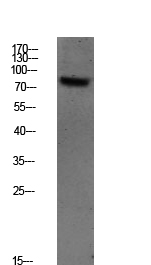
82kD (Observed)
Conjugate/Modification
phosphate
货号: YP1216
规格
价格
货期
数量
200μL
¥4,680.00
现货
0
100μL
¥2,800.00
现货
0
50μL
¥1,500.00
现货
0
加入购物车


已收藏
收藏
详细信息
推荐稀释比
WB 1:500-2000; IHC 1:50-300; ELISA 1:2000-20000
组成
Liquid in PBS containing 50% glycerol, 0.5% BSA and 0.02% sodium azide.
特异性
This detects endogenous levels of SYK (Phospho-Tyr348).The name of modified sites may be influenced by many factors, such as species (the modified site was not originally found in human samples) and the change of protein sequence (the previous protein sequence is incomplete, and the protein sequence may be prolonged with the development of protein sequencing technology). When naming, we will use the "numbers" in historical reference to keep the sites consistent with the reports. The antibody binds to the following modification sequence (lowercase letters are modification sites):EVyES
纯化工艺
The antibody was affinity-purified from rabbit antiserum by affinity-chromatography using epitope-specific immunogen.
储存
-15°C to -25°C/1 year (Do not lower than -25°C)
浓度
1 mg/ml
实测条带
82kD
修饰
phosphate
克隆性
Polyclonal
同种型
IgG
相关产品
Primary Antibodies

Syk Rabbit pAb(N-terminal )
YT6110
预览→
Primary Antibodies
Syk Rabbit pAb
YT4480
预览→
Primary Antibodies
Syk (Phospho Tyr348) Rabbit pAb
YP1216
预览→
Primary Antibodies
Syk (Phospho Tyr323) Rabbit pAb
YP0896
预览→
Primary Antibodies
.jpg)
Syk (Phospho Tyr525) Rabbit pAb
YP0615
预览→
Primary Antibodies
Syk (Phospho Tyr348) Rabbit pAb
YP0614
预览→
Primary Antibodies
Syk (Phospho Tyr352) Rabbit pAb
YP0500
预览→
ELISA Kits
Total Syk Cell-Based Colorimetric ELISA Kit
KA3384C
预览→
ELISA Kits
SYK (Phospho Tyr323) Cell-Based Colorimetric ELISA Kit
KA1338C
预览→
ELISA Kits
SYK (Phospho Tyr525) Cell-Based Colorimetric ELISA Kit
KA1225C
预览→
ELISA Kits
SYK (Phospho Tyr348) Cell-Based Colorimetric ELISA Kit
KA1224C
预览→
抗原&靶点信息
免疫原:
Synthesized phospho derived from human SYK (Phospho-Tyr348)
展开内容
特异性:
This detects endogenous levels of SYK (Phospho-Tyr348).The name of modified sites may be influenced by many factors, such as species (the modified site was not originally found in human samples) and the change of protein sequence (the previous protein sequence is incomplete, and the protein sequence may be prolonged with the development of protein sequencing technology). When naming, we will use the "numbers" in historical reference to keep the sites consistent with the reports. The antibody binds to the following modification sequence (lowercase letters are modification sites):EVyES
展开内容
基因名称:
SYK
展开内容
蛋白名称:
Tyrosine-protein kinase SYK
展开内容
别名:
SYK ;
Tyrosine-protein kinase SYK ;
Spleen tyrosine kinase ;
p72-Syk
Tyrosine-protein kinase SYK ;
Spleen tyrosine kinase ;
p72-Syk
展开内容
背景:
This gene encodes a member of the family of non-receptor type Tyr protein kinases. This protein is widely expressed in hematopoietic cells and is involved in coupling activated immunoreceptors to downstream signaling events that mediate diverse cellular responses , including proliferation , differentiation , and phagocytosis. It is thought to be a modulator of epithelial cell growth and a potential tumour suppressor in human breast carcinomas. Alternatively spliced transcript variants encoding different isoforms have been found for this gene. [provided by RefSeq , Mar 2010] ,
展开内容
功能:
Catalytic activity:ATP + a [protein]-L-tyrosine = ADP + a [protein]-L-tyrosine phosphate. ,Function:Positive effector of BCR-stimulated responses. Couples the B-cell antigen receptor (BCR) to the mobilization of calcium ion either through a phosphoinositide 3-kinase-dependent pathway , when not phosphorylated on tyrosines of the linker region , or through a phospholipase C-gamma-dependent pathway , when phosphorylated on Tyr-348 and Tyr-352. Thus the differential phosphorylation of Syk can determine the pathway by which BCR is coupled to the regulation of intracellular calcium ion. ,PTM:Autophosphorylated. ,PTM:Phosphorylation on Tyr-323 creates a binding site for c-Cbl , an adapter protein that serves as a negative regulator of BCR-stimulated calcium ion signaling. ,PTM:Phosphorylation on Tyr-348 and Tyr-352 enhances the phosphorylation and activation of phospholipase C-gamma and the early phase of calcium ion mobilization via a phosphoinositide 3-kinase-independent pathway. ,PTM:Ubiquitinated by CBLB after BCR activation; which promotes proteasomal degradation. ,similarity:Belongs to the protein kinase superfamily. Tyr protein kinase family. ,similarity:Belongs to the protein kinase superfamily. Tyr protein kinase family. SYK/ZAP-70 subfamily. ,similarity:Contains 1 protein kinase domain. ,similarity:Contains 2 SH2 domains. ,subunit:Interacts with CBL and SLA when it is phosphorylated. The interaction with SLA may link it to CBL , leading to its destruction. Interacts with phosphorylated NFAM1 (By similarity) . Interacts with Epstein-Barr virus LMP2A. Interacts through its SH2 domains with the phosphorylated ITAM domain of CD79A which stimulates SYK autophosphorylation and activation. Interacts with FCRL3. ,
展开内容
细胞定位:
Cell membrane . Cytoplasm , cytosol .
展开内容
研究领域:
>>NF-kappa B signaling pathway ;
>>Phospholipase D signaling pathway ;
>>PI3K-Akt signaling pathway ;
>>Osteoclast differentiation ;
>>Platelet activation ;
>>Neutrophil extracellular trap formation ;
>>C-type lectin receptor signaling pathway ;
>>Natural killer cell mediated cytotoxicity ;
>>B cell receptor signaling pathway ;
>>Fc epsilon RI signaling pathway ;
>>Fc gamma R-mediated phagocytosis ;
>>Tuberculosis ;
>>Kaposi sarcoma-associated herpesvirus infection ;
>>Herpes simplex virus 1 infection ;
>>Epstein-Barr virus infection ;
>>Coronavirus disease - COVID-19 ;
>>Viral carcinogenesis
>>Phospholipase D signaling pathway ;
>>PI3K-Akt signaling pathway ;
>>Osteoclast differentiation ;
>>Platelet activation ;
>>Neutrophil extracellular trap formation ;
>>C-type lectin receptor signaling pathway ;
>>Natural killer cell mediated cytotoxicity ;
>>B cell receptor signaling pathway ;
>>Fc epsilon RI signaling pathway ;
>>Fc gamma R-mediated phagocytosis ;
>>Tuberculosis ;
>>Kaposi sarcoma-associated herpesvirus infection ;
>>Herpes simplex virus 1 infection ;
>>Epstein-Barr virus infection ;
>>Coronavirus disease - COVID-19 ;
>>Viral carcinogenesis
展开内容
信号通路
Organismal Systems >> Immune system >> Platelet activation
Organismal Systems >> Immune system >> Neutrophil extracellular trap formation
Organismal Systems >> Immune system >> Natural killer cell mediated cytotoxicity
Organismal Systems >> Immune system >> B cell receptor signaling pathway
Organismal Systems >> Immune system >> Fc epsilon RI signaling pathway
Organismal Systems >> Immune system >> Fc gamma R-mediated phagocytosis
Organismal Systems >> Development and regeneration >> Osteoclast differentiation
Environmental Information Processing >> Signal transduction >> NF-kappa B signaling pathway
Environmental Information Processing >> Signal transduction >> Phospholipase D signaling pathway
Environmental Information Processing >> Signal transduction >> PI3K-Akt signaling pathway
文献引用({{totalcount}})
货号: YP1216
规格
价格
货期
数量
200μL
¥4,680.00
现货
0
100μL
¥2,800.00
现货
0
50μL
¥1,500.00
现货
0
加入购物车
已收藏
收藏
Recently Viewed Products
Clear all


×

Toggle night Mode
{{pinfoXq.title || ''}}
Catalog: {{pinfoXq.catalog || ''}}
Filter:
All
{{item.name}}
{{pinfo.title}}
-{{pinfo.catalog}}
主要信息
Target
{{pinfo.target}}
Reactivity
{{pinfo.react}}
Applications
{{pinfo.applicat}}
Conjugate/Modification
{{pinfo.coupling}}/{{pinfo.modific}}
MW (kDa)
{{pinfo.mwcalc}}
Host Species
{{pinfo.hostspec}}
Isotype
{{pinfo.isotype}}
产品 {{index}}/{{pcount}}
上一个产品
下一个产品
{{pvTitle}}
滚轮缩放图片
{{pvDescr}}