



Vimentin (Phospho Ser83) Rabbit pAb
-YP0766



主要信息
Target
Vimentin Phospho Ser83
Host Species
Rabbit
Reactivity
Human, Mouse, Rat
Applications
WB, IHC, IF, ELISA
MW
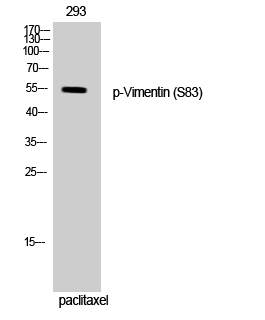
54kD (Observed)
Conjugate/Modification
phosphate
货号: YP0766
规格
价格
货期
数量
200μL
¥4,680.00
现货
0
100μL
¥2,800.00
现货
0
50μL
¥1,500.00
现货
0
加入购物车


已收藏
收藏
详细信息
推荐稀释比
WB 1:500-1:2000; IHC 1:100-1:300; ELISA 1:10000; IF 1:50-200
组成
Liquid in PBS containing 50% glycerol, 0.5% BSA and 0.02% sodium azide.
特异性
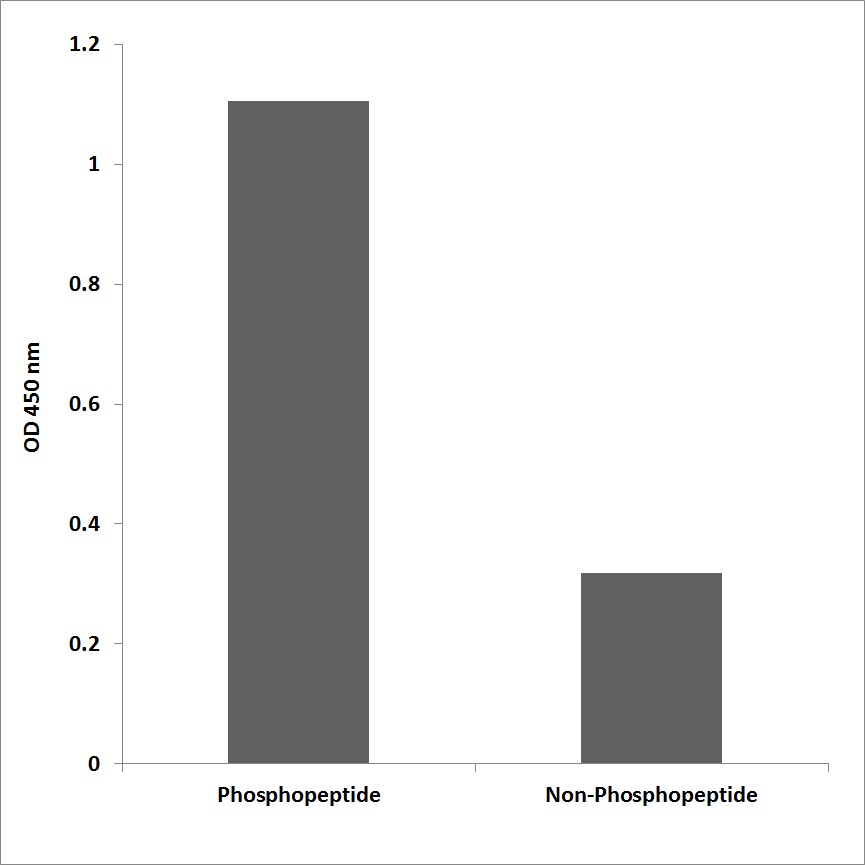
Phospho-Vimentin (S83) Polyclonal Antibody detects endogenous levels of Vimentin protein only when phosphorylated at S83.The name of modified sites may be influenced by many factors, such as species (the modified site was not originally found in human samples) and the change of protein sequence (the previous protein sequence is incomplete, and the protein sequence may be prolonged with the development of protein sequencing technology). When naming, we will use the "numbers" in historical reference to keep the sites consistent with the reports. The antibody binds to the following modification sequence (lowercase letters are modification sites):QDsVD
纯化工艺
The antibody was affinity-purified from rabbit antiserum by affinity-chromatography using epitope-specific immunogen.
储存
-15°C to -25°C/1 year (Do not lower than -25°C)
浓度
1 mg/ml
实测条带
54kD
修饰
phosphate
克隆性
Polyclonal
同种型
IgG
相关产品
Primary Antibodies

Vimentin Rabbit pAb
YT4880
预览→
Primary Antibodies
Vimentin (Phospho Tyr38) Rabbit pAb
YP1209
预览→
Primary Antibodies
Vimentin (Phospho Ser56) Rabbit pAb
YP0767
预览→
Primary Antibodies
Vimentin (Phospho Ser83) Rabbit pAb
YP0766
预览→
Primary Antibodies
Vimentin (Phospho Tyr61) Rabbit pAb
YP0275
预览→
ELISA Kits
Total VIM Cell-Based Colorimetric ELISA Kit
KA3428C
预览→
ELISA Kits
Vimentin (Phospho Ser56) Cell-Based Colorimetric ELISA Kit
KA1539C
预览→
ELISA Kits
Vimentin (Phospho Ser83) Cell-Based Colorimetric ELISA Kit
KA1538C
预览→
抗原&靶点信息
免疫原:
The antiserum was produced against synthesized peptide derived from human Vimentin around the phosphorylation site of Ser83. AA range:56-105
展开内容
特异性:
Phospho-Vimentin (S83) Polyclonal Antibody detects endogenous levels of Vimentin protein only when phosphorylated at S83.The name of modified sites may be influenced by many factors, such as species (the modified site was not originally found in human samples) and the change of protein sequence (the previous protein sequence is incomplete, and the protein sequence may be prolonged with the development of protein sequencing technology). When naming, we will use the "numbers" in historical reference to keep the sites consistent with the reports. The antibody binds to the following modification sequence (lowercase letters are modification sites):QDsVD
展开内容
基因名称:
VIM
展开内容
蛋白名称:
Vimentin
展开内容
别名:
VIM ;
Vimentin
Vimentin
展开内容
背景:
This gene encodes a member of the intermediate filament family. Intermediate filamentents , along with microtubules and actin microfilaments , make up the cytoskeleton. The protein encoded by this gene is responsible for maintaining cell shape , integrity of the cytoplasm , and stabilizing cytoskeletal interactions. It is also involved in the immune response , and controls the transport of low-density lipoprotein (LDL) -derived cholesterol from a lysosome to the site of esterification. It functions as an organizer of a number of critical proteins involved in attachment , migration , and cell signaling. Mutations in this gene causes a dominant , pulverulent cataract.[provided by RefSeq , Jun 2009] ,
展开内容
功能:
Function:Vimentins are class-III intermediate filaments found in various non-epithelial cells , especially mesenchymal cells. ,online information:Vimentin entry ,PTM:One of the most prominent phosphoproteins in various cells of mesenchymal origin. Phosphorylation is enhanced during cell division , at which time vimentin filaments are significantly reorganized. ,sequence Caution:Intron retention. ,similarity:Belongs to the intermediate filament family. ,subunit:Homopolymer. Interacts with HCV core protein. Interacts with LGSN and SYNM. ,tissue specificity:Highly expressed in fibroblasts , some expression in T- and B-lymphocytes , and little or no expression in Burkitt's lymphoma cell lines. Expressed in many hormone-independent mammary carcinoma cell lines. ,
展开内容
细胞定位:
Cytoplasm . Cytoplasm , cytoskeleton . Nucleus matrix . Cell membrane .
展开内容
研究领域:
>>Epstein-Barr virus infection ;
>>MicroRNAs in cancer
>>MicroRNAs in cancer
展开内容
文献引用({{totalcount}})
货号: YP0766
规格
价格
货期
数量
200μL
¥4,680.00
现货
0
100μL
¥2,800.00
现货
0
50μL
¥1,500.00
现货
0
加入购物车
已收藏
收藏
Recently Viewed Products
Clear all


×

Toggle night Mode
{{pinfoXq.title || ''}}
Catalog: {{pinfoXq.catalog || ''}}
Filter:
All
{{item.name}}
{{pinfo.title}}
-{{pinfo.catalog}}
主要信息
Target
{{pinfo.target}}
Reactivity
{{pinfo.react}}
Applications
{{pinfo.applicat}}
Conjugate/Modification
{{pinfo.coupling}}/{{pinfo.modific}}
MW (kDa)
{{pinfo.mwcalc}}
Host Species
{{pinfo.hostspec}}
Isotype
{{pinfo.isotype}}
产品 {{index}}/{{pcount}}
上一个产品
下一个产品
{{pvTitle}}
滚轮缩放图片
{{pvDescr}}