



SMC1 (Phospho Ser966) Rabbit pAb
-YP0671




主要信息
Target
SMC1 Phospho Ser966
Host Species
Rabbit
Reactivity
Human, Mouse, Rat
Applications
WB, IHC, IF, ELISA
MW
160kD (Observed)
Conjugate/Modification
phosphate
货号: YP0671
规格
价格
货期
数量
200μL
¥4,680.00
现货
0
100μL
¥2,800.00
现货
0
50μL
¥1,500.00
现货
0
加入购物车


已收藏
收藏
详细信息
推荐稀释比
WB 1:500-1:2000; IHC 1:100-1:300; ELISA 1:10000; IF 1:50-200
组成
Liquid in PBS containing 50% glycerol, 0.5% BSA and 0.02% sodium azide.
特异性
Phospho-SMC1 (S966) Polyclonal Antibody detects endogenous levels of SMC1 protein only when phosphorylated at S966.The name of modified sites may be influenced by many factors, such as species (the modified site was not originally found in human samples) and the change of protein sequence (the previous protein sequence is incomplete, and the protein sequence may be prolonged with the development of protein sequencing technology). When naming, we will use the "numbers" in historical reference to keep the sites consistent with the reports. The antibody binds to the following modification sequence (lowercase letters are modification sites):SGsQR
纯化工艺
The antibody was affinity-purified from rabbit antiserum by affinity-chromatography using epitope-specific immunogen.
储存
-15°C to -25°C/1 year (Do not lower than -25°C)
浓度
1 mg/ml
实测条带
160kD
修饰
phosphate
克隆性
Polyclonal
同种型
IgG
相关产品
Primary Antibodies

SMC1 Rabbit pAb
YT4340
预览→
Primary Antibodies
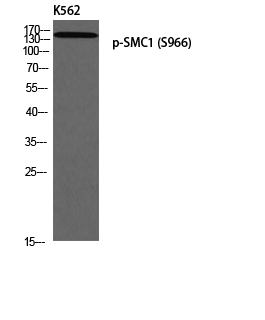
SMC1 (Phospho Ser966) Rabbit pAb
YP0671
预览→
Primary Antibodies
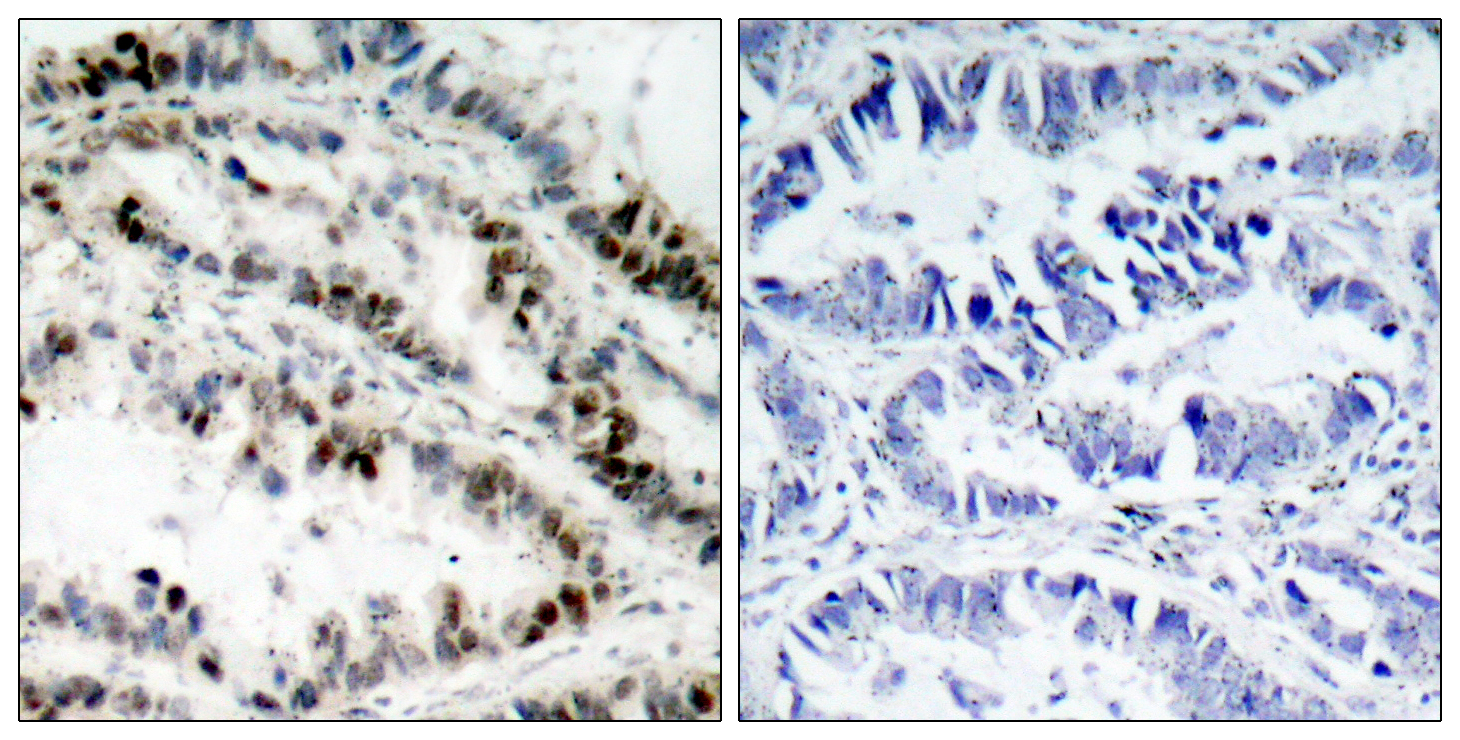
SMC1 (Phospho Ser957) Rabbit pAb
YP0246
预览→
ELISA Kits
Total SMC1 Cell-Based Colorimetric ELISA Kit
KA4284C
预览→
ELISA Kits
SMC1 (Phospho Ser957) Cell-Based Colorimetric ELISA Kit
KA1652C
预览→
ELISA Kits
SMC1 (Phospho Ser966) Cell-Based Colorimetric ELISA Kit
KA1335C
预览→
抗原&靶点信息
免疫原:
The antiserum was produced against synthesized peptide derived from human SMC1 around the phosphorylation site of Ser966. AA range:932-981
展开内容
特异性:
Phospho-SMC1 (S966) Polyclonal Antibody detects endogenous levels of SMC1 protein only when phosphorylated at S966.The name of modified sites may be influenced by many factors, such as species (the modified site was not originally found in human samples) and the change of protein sequence (the previous protein sequence is incomplete, and the protein sequence may be prolonged with the development of protein sequencing technology). When naming, we will use the "numbers" in historical reference to keep the sites consistent with the reports. The antibody binds to the following modification sequence (lowercase letters are modification sites):SGsQR
展开内容
基因名称:
SMC1A
展开内容
蛋白名称:
Structural maintenance of chromosomes protein 1A
展开内容
别名:
SMC1A ;
DXS423E ;
KIAA0178 ;
SB1.8 ;
SMC1 ;
SMC1L1 ;
Structural maintenance of chromosomes protein 1A ;
SMC protein 1A ;
SMC-1-alpha ;
SMC-1A ;
Sb1.8
DXS423E ;
KIAA0178 ;
SB1.8 ;
SMC1 ;
SMC1L1 ;
Structural maintenance of chromosomes protein 1A ;
SMC protein 1A ;
SMC-1-alpha ;
SMC-1A ;
Sb1.8
展开内容
背景:
structural maintenance of chromosomes 1A (SMC1A) Homo sapiens Proper cohesion of sister chromatids is a prerequisite for the correct segregation of chromosomes during cell division. The cohesin multiprotein complex is required for sister chromatid cohesion. This complex is composed partly of two structural maintenance of chromosomes (SMC) proteins , SMC3 and either SMC1B or the protein encoded by this gene. Most of the cohesin complexes dissociate from the chromosomes before mitosis , although those complexes at the kinetochore remain. Therefore , the encoded protein is thought to be an important part of functional kinetochores. In addition , this protein interacts with BRCA1 and is phosphorylated by ATM , indicating a potential role for this protein in DNA repair. This gene , which belongs to the SMC gene family , is located in an area of the X-chromosome that escapes X inactivation. Mutations in this gene result in Cornelia de Lange syndrome. Alternative splicing results in multiple transcript variants encoding different isoforms. [provided by RefSeq , Jul 2013]
展开内容
功能:
Disease:Defects in SMC1A are the cause of Cornelia de Lange syndrome type 2 (CDLS2) [MIM:300590]; also known as Cornelia de Lange syndrome X-linked. CDLS is a clinically heterogeneous developmental disorder associated with malformations affecting multiple systems. CDLS is characterized by facial dysmorphisms , abnormal hands and feet , growth delay , cognitive retardation and various other malformations including gastroesophageal dysfunction and cardiac , ophthalmologic and genitourinary anomalies. ,Domain:The flexible hinge domain , which separates the large intramolecular coiled coil regions , allows the heterotypic interaction with the corresponding domain of SMC3 , forming a V-shaped heterodimer. The two heads of the heterodimer are then connected by different ends of the cleavable RAD21 protein , forming a ring structure. ,Function:Involved in chromosome cohesion during cell cycle and in DNA repair. Central component of cohesin complex. The cohesin complex is required for the cohesion of sister chromatids after DNA replication. The cohesin complex apparently forms a large proteinaceous ring within which sister chromatids can be trapped. At anaphase , the complex is cleaved and dissociates from chromatin , allowing sister chromatids to segregate. The cohesin complex may also play a role in spindle pole assembly during mitosis. Involved in DNA repair via its interaction with BRCA1 and its related phosphorylation by ATM , or via its phosphorylation by ATR. Works as a downstream effector both in the ATM/NBS1 branch and in the ATR/MSH2 branch of S-phase checkpoint. ,PTM:Phosphorylated by ATM upon ionizing radiation in a NBS1-dependent manner. Phosphorylated by ATR upon DNA methylation in a MSH2/MSH6-dependent manner. Phosphorylation of Ser-957 and Ser-966 activates it and is required for S-phase checkpoint activation. ,similarity:Belongs to the SMC family. SMC1 subfamily. ,subcellular location:Associates with chromatin. Before prophase it is scattered along chromosome arms. During prophase , most of cohesin complexes dissociate from chromatin probably because of phosphorylation by PLK , except at centromeres , where cohesin complexes remain. At anaphase , the RAD21 subunit of the cohesin complex is cleaved , leading to the dissociation of the complex from chromosomes , allowing chromosome separation. In germ cells , cohesin complex dissociates from chromatin at prophase I , and may be replaced by a meiosis-specific cohesin complex. The phosphorylated form on Ser-957 and Ser-966 associates with chromatin during G1/S/G2 phases but not during M phase , suggesting that phosphorylation does not regulate cohesin function. Integral component of the functional centromere-kinetochore complex at the kinetochore region during mitosis. ,subunit:Interacts with POLE. Interacts with SYCP2. Interacts with BRCA1. Found in a complex with CDCA5 , SMC3 and RAD21 , PDS5A/APRIN and PDS5B/SCC-112 (By similarity) . Forms a heterodimer with SMC3 in cohesin complexes. Cohesin complexes are composed of the SMC1 (SMC1A or SMC1B) and SMC3 heterodimer attached via their hinge domain , RAD21 which link them , and one STAG protein (STAG1 , STAG2 or STAG3) , which interacts with RAD21. In germ cell cohesin complexes , SMC1A is mutually exclusive with SMC1B. Interacts with BRCA1. Interacts with NDC80. ,
展开内容
细胞定位:
Nucleus . Chromosome . Chromosome , centromere , kinetochore . Associates with chromatin. Before prophase it is scattered along chromosome arms. During prophase , most of cohesin complexes dissociate from chromatin probably because of phosphorylation by PLK , except at centromeres , where cohesin complexes remain. At anaphase , the RAD21 subunit of the cohesin complex is cleaved , leading to the dissociation of the complex from chromosomes , allowing chromosome separation. In germ cells , cohesin complex dissociates from chromatin at prophase I , and may be replaced by a meiosis-specific cohesin complex. The phosphorylated form on Ser-957 and Ser-966 associates with chromatin during G1/S/G2 phases but not during M phase , suggesting that phosphorylation does not regulate cohesin function. Integral component of the functional centromere-kinetochore complex at the kinetochore region during mitosis.
展开内容
研究领域:
>>Cell cycle ;
>>Oocyte meiosis
>>Oocyte meiosis
展开内容
文献引用({{totalcount}})
货号: YP0671
规格
价格
货期
数量
200μL
¥4,680.00
现货
0
100μL
¥2,800.00
现货
0
50μL
¥1,500.00
现货
0
加入购物车
已收藏
收藏
Recently Viewed Products
Clear all


×

Toggle night Mode
{{pinfoXq.title || ''}}
Catalog: {{pinfoXq.catalog || ''}}
Filter:
All
{{item.name}}
{{pinfo.title}}
-{{pinfo.catalog}}
主要信息
Target
{{pinfo.target}}
Reactivity
{{pinfo.react}}
Applications
{{pinfo.applicat}}
Conjugate/Modification
{{pinfo.coupling}}/{{pinfo.modific}}
MW (kDa)
{{pinfo.mwcalc}}
Host Species
{{pinfo.hostspec}}
Isotype
{{pinfo.isotype}}
产品 {{index}}/{{pcount}}
上一个产品
下一个产品
{{pvTitle}}
滚轮缩放图片
{{pvDescr}}