


SIRT1 (Phospho Ser47) Rabbit pAb
-YP0488



主要信息
Target
SIRT1 Phospho Ser47
Host Species
Rabbit
Reactivity
Human, Mouse
Applications
WB, IHC, ELISA
MW
85-110kD (Observed)
Conjugate/Modification
phosphate
货号: YP0488
规格
价格
货期
数量
200μL
¥4,680.00
现货
0
100μL
¥2,800.00
现货
0
50μL
¥1,500.00
现货
0
加入购物车


已收藏
收藏
详细信息
推荐稀释比
WB 1:500-2000; IHC 1:50-300; ELISA 1:2000-20000
组成
Liquid in PBS containing 50% glycerol, 0.5% BSA and 0.02% sodium azide.
特异性
Phospho-SIRT1 (S47) Polyclonal Antibody detects endogenous levels of SIRT1 protein only when phosphorylated at S47.The name of modified sites may be influenced by many factors, such as species (the modified site was not originally found in human samples) and the change of protein sequence (the previous protein sequence is incomplete, and the protein sequence may be prolonged with the development of protein sequencing technology). When naming, we will use the "numbers" in historical reference to keep the sites consistent with the reports. The antibody binds to the following modification sequence (lowercase letters are modification sites):ERsPG
纯化工艺
The antibody was affinity-purified from rabbit antiserum by affinity-chromatography using epitope-specific immunogen.
储存
-15°C to -25°C/1 year (Do not lower than -25°C)
浓度
1 mg/ml
实测条带
85-110kD
修饰
phosphate
克隆性
Polyclonal
同种型
IgG
相关产品
Primary Antibodies

SIRT1 Rabbit pAb
YT4302
预览→
Primary Antibodies
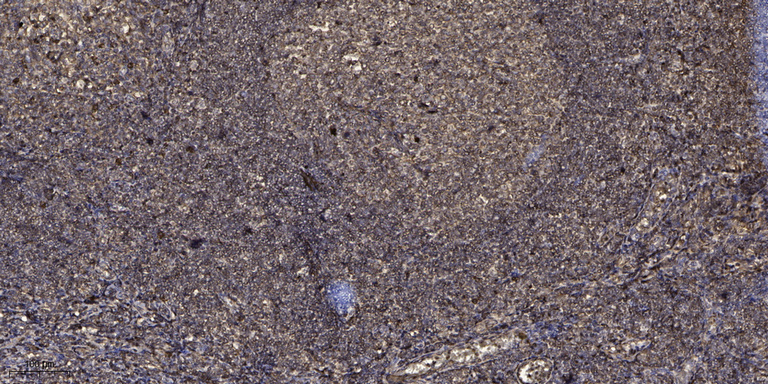
SIRT1 (Phospho Ser47) Rabbit pAb
YP0488
预览→
Primary Antibodies
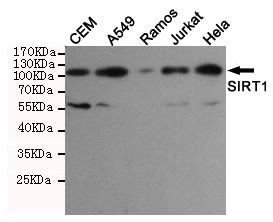
SIRT1 Mouse mAb
YM1416
预览→
Primary Antibodies
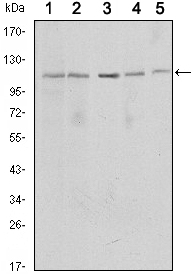
SIRT1 Mouse mAb
YM0578
预览→
抗原&靶点信息
免疫原:
Synthesized phospho-peptide around the phosphorylation site of human SIRT1 (phospho Ser47)
展开内容
特异性:
Phospho-SIRT1 (S47) Polyclonal Antibody detects endogenous levels of SIRT1 protein only when phosphorylated at S47.The name of modified sites may be influenced by many factors, such as species (the modified site was not originally found in human samples) and the change of protein sequence (the previous protein sequence is incomplete, and the protein sequence may be prolonged with the development of protein sequencing technology). When naming, we will use the "numbers" in historical reference to keep the sites consistent with the reports. The antibody binds to the following modification sequence (lowercase letters are modification sites):ERsPG
展开内容
基因名称:
SIRT1
展开内容
蛋白名称:
NAD-dependent protein deacetylase sirtuin-1
展开内容
别名:
SIRT1 ;
SIR2L1 ;
NAD-dependent protein deacetylase sirtuin-1 ;
hSIRT1 ;
Regulatory protein SIR2 homolog 1 ;
SIR2-like protein 1 ;
hSIR2
SIR2L1 ;
NAD-dependent protein deacetylase sirtuin-1 ;
hSIRT1 ;
Regulatory protein SIR2 homolog 1 ;
SIR2-like protein 1 ;
hSIR2
展开内容
背景:
This gene encodes a member of the sirtuin family of proteins , homologs to the yeast Sir2 protein. Members of the sirtuin family are characterized by a sirtuin core domain and grouped into four classes. The functions of human sirtuins have not yet been determined; however , yeast sirtuin proteins are known to regulate epigenetic gene silencing and suppress recombination of rDNA. Studies suggest that the human sirtuins may function as intracellular regulatory proteins with mono-ADP-ribosyltransferase activity. The protein encoded by this gene is included in class I of the sirtuin family. Alternative splicing results in multiple transcript variants. [provided by RefSeq , Dec 2008] ,
展开内容
功能:
Catalytic activity:NAD (+) + an acetylprotein = nicotinamide + O-acetyl-ADP-ribose + a protein. ,cofactor:Binds 1 zinc ion per subunit. ,enzyme regulation:Inhibited by nicotinamide. Activated by resveratrol (3 ,5 ,4'-trihydroxy-trans-stilbene) , butein (3 ,4 ,2' ,4'-tetrahydroxychalcone) , piceatannol (3 ,5 ,3' ,4'-tetrahydroxy-trans-stilbene) , Isoliquiritigenin (4 ,2' ,4'-trihydroxychalcone) , fisetin (3 ,7 ,3' ,4'-tetrahydroxyflavone) and quercetin (3 ,5 ,7 ,3' ,4'-pentahydroxyflavone) . RPS19BP1/AROS acts as a positive regulator of deacetylation activity. ,Function:NAD-dependent deacetylase , which regulates processes such as apoptosis and muscle differentiation by deacetylating key proteins. Deacetylates 'Lys-382' of p53/TP53 and impairs its ability to induce proapoptotic program and modulate cell senescence. Deacetylates TAF1B and thereby represses rDNA transcription by the RNA polymerase I. Involved in HES1- and HEY2-mediated transcriptional repression. Inhibits skeletal muscle differentiation by deacetylating PCAF and MYOD1. May serve as a sensor of the cytosolic ratio of NAD (+) /NADH , which is essential in skeletal muscle cell differentiation. Despite some ability to deacetylate histones in vitro , such activity is either weak or inexistent in vivo. In case of HIV-1 infection , interacts with and deacetylates the viral Tat protein. ,miscellaneous:Red wine , which contains resveratrol , may participate in activation of sirtuin proteins , and may therefore participate in an extended lifespan as it has been observed in yeast. ,similarity:Belongs to the sirtuin family. ,similarity:Contains 1 deacetylase sirtuin-type domain. ,subcellular location:Recruited to the nuclear bodies via its interaction with PML. ,subunit:Interacts with TAF1B. Found in a complex with PCAF and MYOD1 (By similarity) . Interacts with MLLT7/FOXO4 , HES1 , HEY2 , p53/TP53 and PML. Interacts with RPS19BP1/AROS. ,tissue specificity:Widely expressed. ,
展开内容
细胞定位:
Nucleus , PML body . Cytoplasm . Nucleus . Recruited to the nuclear bodies via its interaction with PML (PubMed:12006491) . Colocalized with APEX1 in the nucleus (PubMed:19934257) . May be found in nucleolus , nuclear euchromatin , heterochromatin and inner membrane (PubMed:15469825) . Shuttles between nucleus and cytoplasm (By similarity) . Colocalizes in the nucleus with XBP1 isoform 2 (PubMed:20955178) . .; [SirtT1 75 kDa fragment]: Cytoplasm . Mitochondrion .
展开内容
组织表达:
展开内容
研究领域:
>>Nicotinate and nicotinamide metabolism ;
>>Metabolic pathways ;
>>FoxO signaling pathway ;
>>AMPK signaling pathway ;
>>Longevity regulating pathway ;
>>Longevity regulating pathway - multiple species ;
>>Cellular senescence ;
>>Glucagon signaling pathway ;
>>Alcoholic liver disease ;
>>Amphetamine addiction ;
>>MicroRNAs in cancer
>>Metabolic pathways ;
>>FoxO signaling pathway ;
>>AMPK signaling pathway ;
>>Longevity regulating pathway ;
>>Longevity regulating pathway - multiple species ;
>>Cellular senescence ;
>>Glucagon signaling pathway ;
>>Alcoholic liver disease ;
>>Amphetamine addiction ;
>>MicroRNAs in cancer
展开内容
信号通路
Cellular Processes >> Cell growth and death >> Cellular senescence
Organismal Systems >> Endocrine system >> Glucagon signaling pathway
Organismal Systems >> Aging >> Longevity regulating pathway
Organismal Systems >> Aging >> Longevity regulating pathway - multiple species
Human Diseases >> Cancer: overview >> MicroRNAs in cancer
Environmental Information Processing >> Signal transduction >> Wnt signaling pathway
Environmental Information Processing >> Signal transduction >> FoxO signaling pathway
Environmental Information Processing >> Signal transduction >> AMPK signaling pathway
文献引用({{totalcount}})
货号: YP0488
规格
价格
货期
数量
200μL
¥4,680.00
现货
0
100μL
¥2,800.00
现货
0
50μL
¥1,500.00
现货
0
加入购物车
已收藏
收藏
Recently Viewed Products
Clear all


×

Toggle night Mode
{{pinfoXq.title || ''}}
Catalog: {{pinfoXq.catalog || ''}}
Filter:
All
{{item.name}}
{{pinfo.title}}
-{{pinfo.catalog}}
主要信息
Target
{{pinfo.target}}
Reactivity
{{pinfo.react}}
Applications
{{pinfo.applicat}}
Conjugate/Modification
{{pinfo.coupling}}/{{pinfo.modific}}
MW (kDa)
{{pinfo.mwcalc}}
Host Species
{{pinfo.hostspec}}
Isotype
{{pinfo.isotype}}
产品 {{index}}/{{pcount}}
上一个产品
下一个产品
{{pvTitle}}
滚轮缩放图片
{{pvDescr}}